



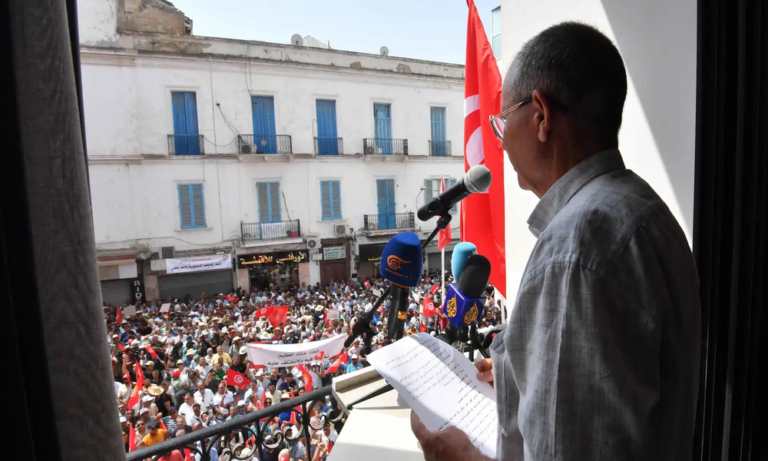
Renewed protests by internal opposition factions have exposed a deepening governance crisis within the Tunisian General Labour Union (UGTT).
Its internal divisions are weakening the UGTT’s historic role at a time of heightened political and social tension in the country.
Trade union opposition groups in Tunisia have ratcheted up criticism of the UGTT leadership, highlighting a troubling deterioration in internal governance just weeks ahead of a decisive electoral congress.
These mobilisations reflect not a temporary disagreement, but a structural malaise fuelled by internal rivalries and a gradual loss of strategic direction.
Opposition coordinator Qassem Afia has called for the swift launch of an inclusive internal dialogue, arguing that the current crisis cannot be resolved without a profound restructuring of the organisation.
The proposal to establish a joint commission bringing together the various union factions to map out a roadmap for reconstruction underscores both the scale of the disagreements and the leadership’s current inability to unify the organisation.
The tensions erupted shortly after Secretary-General Noureddine Taboubi reversed his earlier decision to resign, a move initially framed as a gesture of de-escalation. Rather than easing tensions, the reversal has laid bare a deep crisis of confidence at the top of the UGTT, revealing an organisation caught between preserving internal balances and navigating an increasingly restrictive political environment.
According to political analyst Hichem El Hajj, the crisis is unprecedented in the union’s history. He attributes it to the convergence of intense internal pressures and a latent confrontation with political authorities, exacerbated by sensitive decisions such as the cancellation of the automatic payroll deduction mechanism for union dues. That measure has weakened the UGTT’s financial position and intensified pressure on its leadership ahead of a planned extraordinary congress.
El Hajj notes that Taboubi’s continued leadership does not automatically worsen the situation, but neither does it guarantee an exit from the crisis. Much will depend on how the congress is prepared, he argues, stressing that it must move beyond narrow electoral considerations to avoid a prolonged deadlock that could paralyse union action.
Analyst Mohamed Saleh El Abidi believes the persistence of protests reflects a widening gap between the executive bureau and its opponents, driven by uncertainty surrounding the direction of the upcoming congress. This escalation of internal divisions, he warns, risks undermining the UGTT’s ability to play its historic role as a social mediator and a central actor on Tunisia’s national stage.
MK/sf/lb/as/APA