





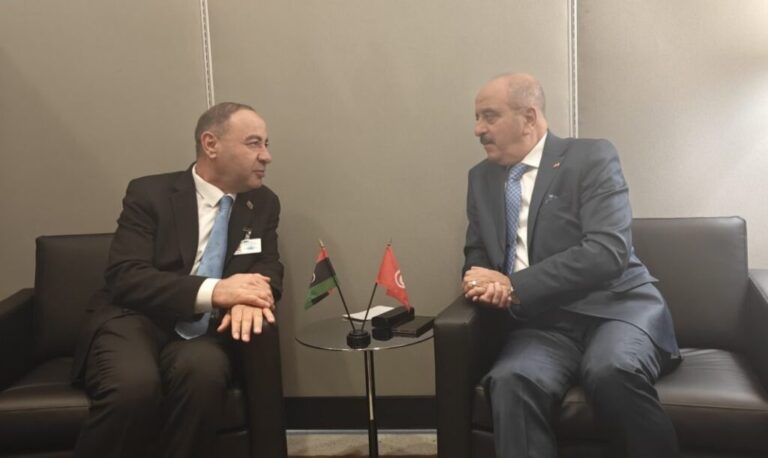
Tunisia and Libya have pledged to strengthen their bilateral cooperation on border and consular issues.
The commitment came during a meeting between Tunisian Foreign Minister Mohamed Ali Nafti and his Libyan counterpart, Tahar Baour, on the sidelines of the 80th United Nations General Assembly in New York.
According to a statement from the Tunisian Foreign Ministry, the two officials agreed to “quickly resolve” outstanding consular matters and “facilitate the movement of goods and passengers” at their shared border crossings.
Despite the diplomatic rhetoric, significant challenges remain. The border crossings at Ras Jedir and Dhehiba are frequently subject to blockades and tensions, disrupting the daily lives of local populations who rely on cross-border trade for their livelihood. This reliance on trade, combined with the presence of smuggling and trafficking networks and migratory flows, makes the border a sensitive and unstable area.
For many observers, the meeting yielded few concrete measures to strengthen security or develop cross-border projects that could bring lasting stability to the region. The lack of a genuine action plan makes the discussions seem more symbolic than operational.
Tunisia’s foreign minister reiterated the country’s commitment to a “Libyan-Libyan” solution under the auspices of the UN. However, Tunisia’s role in the peace process remains marginal, even as it faces the direct consequences of its neighbor’s instability. The promise of “unshakeable unity” between the two nations appears to be more of a diplomatic posture than a tangible reality, with a disconnect between these high-level declarations and the urgent issues facing both countries.
MK/ac/fss/abj/APA