





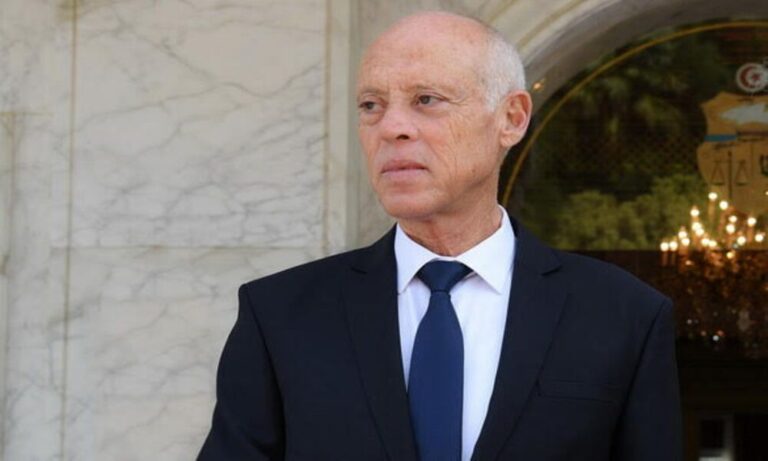
In Tunis, a rally of supporters of President Kais Saied for the fifteenth anniversary of the revolution highlighted an increasingly conflicted interpretation of the legacy of the 2011 uprising, against the backdrop of growing protests over the loss of civil liberties.
More than 2,000 people gathered on Wednesday, December 17, in thestreets of Tunis to celebrate the fifteenth anniversary of the revolution that led to the fall of President Zine El Abidine Ben Ali.
The rally, organised by supporters of President Kais Saied, transformed into a demonstration of explicit political support for the head of state amid increased polarisation of the Tunisian political scene.
At the heart of the demonstration, an emblematic slogan of the Arab Spring was reappropriated and subverted. The cry “The people want the fall of the regime,” a symbol of the 2011 popular protest, gave way to “The people want Kais Saied again.”
For many observers, this reinterpretation of revolutionary vocabulary illustrates a profound
break with the original spirit of the revolution, founded on the demand for freedoms, political pluralism, and institutional checks and balances.
The participants, some of whom came from distant regions such as Gafsa, Kasserine, Kairouan, and Sousse, emphasised recurring themes in the presidential discourse, notably national sovereignty and the rejection of any “foreign interference.”
Several slogans also targeted opposition figures, particularly Rached Ghannouchi, head of the
Ennahdha party, who is currently imprisoned. This focus on political adversaries contributes to reinforcing a climate of confrontation rather than national reconciliation.
This mobilisation comes at a time when numerous human rights groups are denouncing the continued erosion of freedoms in Tunisia.
The arrests of politicians and journalists, the prosecution of opponents, restrictions on freedom of expression, and the weakening of independent institutions are regularly cited as signs of democratic
backsliding since Kais Saied consolidated power starting in 2021.
For some, the public support for the president reflects weariness with a decade of political instability and economic hardship. For others, it reveals a worrying normalisation of increasingly personalised
power, at the expense of the democratic gains achieved through the revolution.
Fifteen years after 2011, the celebration of Ben Ali’s fall thus appears less as a moment of national unity than as a reflection of a country deeply divided over the meaning and future of its democratic experiment.
MK/AK/fss/as/APA