



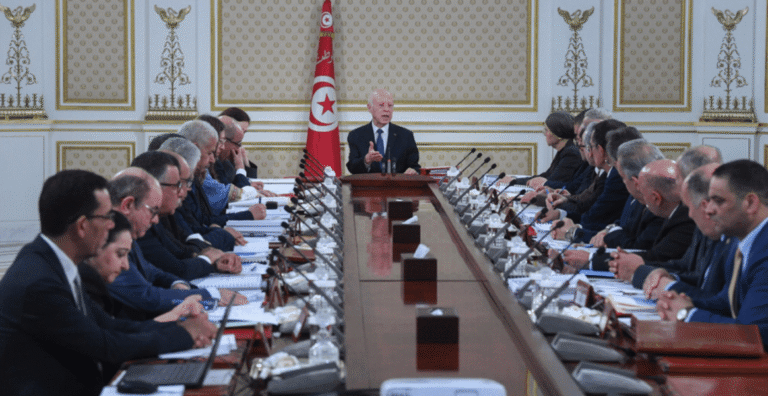
Tunisian President Kais Saied has expressed his firm intention to launch a comprehensive administrative reform, grounded in the principles of efficiency, transparency, and social justice.
This directive came during a meeting with Sarra Zaafrani, President of the Caisse des Dépôts et Consignations (CDC), on Tuesday.
In a context marked by persistent economic tensions and growing public distrust in institutions, President Saied is refocusing his political discourse on enhancing the performance of public services and ensuring administrative fairness. During an audience held on Monday, July 7, at the Carthage Palace, which also included Sarra Zaâfrani (Minister of Public Works and President of the CDC), Saied emphasized the critical need to “rethink the logic of public action to ensure equitable access to essential services and restore Tunisians’ trust in their institutions.”
The President sharply criticized “an administration that has become an end in itself, divorced from social reality, and trapped by ineffective routines,” calling for a complete modernization. He specifically highlighted the urgent need to digitize procedures, strengthen local capacities, and redirect public funds to marginalized areas.
The Caisse des Dépôts et Consignations (CDC), a strategic institution vital for financing territorial development, is expected to play a central role in this reform effort. President Saied hopes that the CDC’s funds will be more effectively channeled toward projects with significant local impact, particularly in the sectors of community healthcare, urban planning, and renewable energy. “We must invest where the state is expected, not where private interests dictate priorities,” he firmly declared.
This presidential statement follows the recent release of several parliamentary reports that underscore the structural sluggishness of the administration and the ineffectiveness of public investment programs. Data from the National Foresight Authority indicates that governorates such as Kasserine, Tataouine, and Jendouba are among the most disadvantaged in terms of public infrastructure.
Against this backdrop, this institutional offensive by President Saied could also be seen as part of the preparations for the upcoming municipal elections scheduled for November. By focusing on a visible reform of public services, President Saied likely aims to consolidate his electoral base while further marginalizing political parties, which he consistently accuses of paralysis and corruption.
MK/ac/Sf/fss/abj/APA