



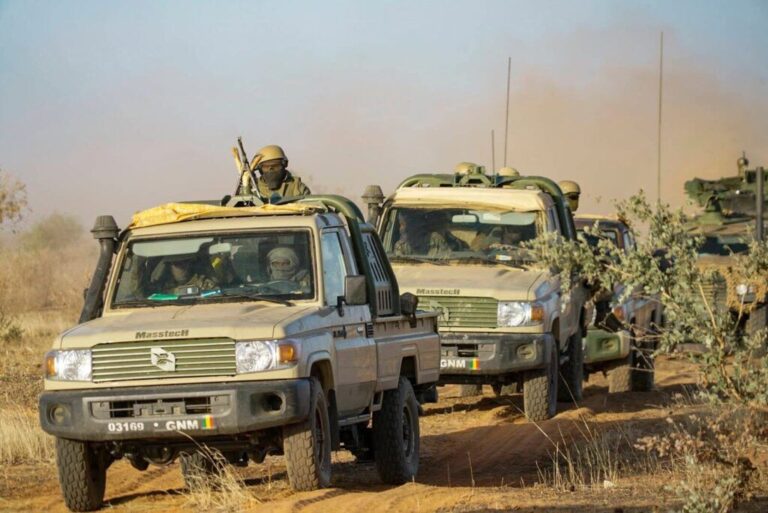
Eighty-two Malian soldiers held captive since the coordinated attacks of April 25 were released on Thursday, the army’s general staff announced, without specifying the conditions of their release.
The soldiers, now “safe,” are being cared for by the relevant authorities, according to the statement. The army attributes their detention to armed groups affiliated with what Bamako describes as the coalition formed by the Group for the Support of Islam and Muslims (GSIM), linked to Al-Qaeda, and the Azawad Liberation Front (FLA) an independence movement active in the north of the country.
The general staff describes this release as the culmination of a “process initiated as soon as they were captured,” based on coordinated planning and mobilisation.
However, the statement makes no mention of any assault, confrontation, or other recovery operation, nor does it specify the location of the release, the identity of any intermediaries, or the existence of any quid pro quo.
Sources close to the FLA cite social and humanitarian considerations, a version that had not yet been elaborated upon in a detailed public statement from the movement on Thursday.
Contacts
The simultaneous release of 82 men suggests the existence of a direct or indirect channel of contact between the parties. However, it is not sufficient to establish the opening of a political dialogue or formal negotiations between Bamako and the armed groups in the north.
This development comes in the wake of the détente initiated between Mali and Algeria. The two countries reinstated their ambassadors and reopened their airspace on July 10. Malian Prime Minister Abdoulaye Maiga subsequently stated that there was “no break in diplomatic relations” between the two neighbours, before receiving an invitation from his Algerian counterpart, Sifi Ghrieb for a working visit to Algiers.
Nevertheless, no public evidence links Algeria to the soldiers’ release. On July 31, the FLA released a video showing more than 200 detained members of the Malian armed forces.
According to the movement, this group included soldiers captured on April 25 during the fall of Kidal, as well as others taken prisoner in July during the fighting in Anéfis and Tabrichat.
The announced release thus represents a significant humanitarian step forward. Its potential political impact will depend on the information released regarding the terms of the release and the fate of the other soldiers still being held.
MD/ac/fss/as/APA