





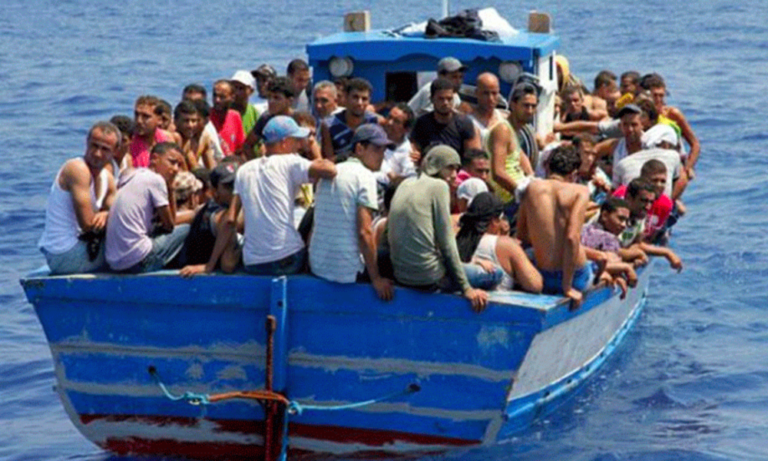
Migrant arrivals in Italy fell by 56.2% during the first ten months of 2026, while departures from Algeria rose sharply.
This shift raises questions about the effectiveness of migration control policies in the Maghreb and the impact of Europe’s stricter stance.
While migrant arrivals on Italian shores have seen a marked decline, the routes taken from North Africa show contrasting trends.
According to data cited by former Tunisian MP Majdi Karbai, Italy recorded 24,092 arrivals in the first ten months of 2026, down from 54,965 during the same period in 2025 – a decrease of 56.2%.
Beneath this overall drop, figures for Tunisia continue to fall, whereas Algeria is seeing an increase that propels it into the ranks of the primary countries of departure.
The contraction of the Tunisian route is particularly pronounced.
Arrivals from Tunisia fell from 7,158 in 2024 to 1,519 in 2025, and then to 1,275 during the first ten months of 2026. Over the period in question, this represents an 82.2% decrease compared to 2024.
This trend reflects a profound shift in migration flows toward Italy, although the available figures alone cannot be attributed to any single policy.
Factors such as tightened controls, security cooperation with European partners, and changes in available routes must be examined to explain this trend.
The trajectory for Algeria is the opposite. After not appearing among the top ten nationalities recorded in 2024, Algeria ranked twelfth in 2025, with 1,115 arrivals.
During the first ten months of 2026, this figure rose to 2,760 – an increase of nearly two-and-a-half-fold in a single year.
Algerian nationals thus rank ahead of Somalis (2,745 recorded arrivals), Eritreans (1,973), and Sudanese (1,776).
These data indicate a shift in migration routes, without demonstrating that departures from Algeria directly account for the decline observed in departures from Tunisia.
This development comes as the European Union strengthens its migration policy framework. The European Pact on Migration and Asylum – whose main provisions took effect on June 12, 2026 – aims to harmonise procedures for registration, screening, and the processing of asylum applications.
At the same time, European institutions are seeking to accelerate the return of individuals without a right to stay and to expand cooperation with third countries.
However, the strategy’s effectiveness depends on its implementation, the administrative capacity of member states, and effective cooperation from partner countries.
MK/AK/Sf/fss/as/APA