





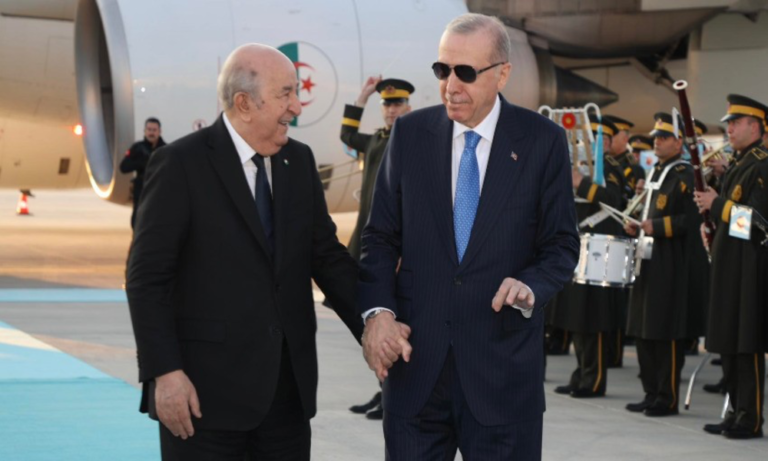
President Abdelmadjid Tebboune has begun a three-day official visit to Ankara, marked by the announcement of new agreements, in a context where the real economic impact of the partnership remains a subject of debate.
The Algerian president was received in Ankara by his Turkish counterpart, Recep Tayyip Erdoğan, for an official visit focused on strengthening bilateral relations, according to a statement from the
Algerian presidency.
The two leaders are to co-chair the first session of the High-Level Strategic Cooperation Council, a body created in 2020 and rebranded in 2023 to reflect the stated political ambitions between the two countries.
The meeting is expected to lead to the signing of several agreements aimed at consolidating the legal framework for economic and political relations. The authorities are highlighting expanded cooperation across several sectors, with the participation of ministers from both sides. The Turkish presidency mentions a comprehensive review of the partnership and the identification of new areas of cooperation.
Available economic data reflects a surge in trade, which reached approximately $6 billion (nearly €5.5 billion), with a stated target of $10 billion (approximately €9.2 billion).
Turkish investments in Algeria are estimated at over $6 billion (approximately €5.5 billion), with projections reaching $16 billion (nearly €14.7 billion), according to figures cited by the authorities.
Despite these volumes, several observers point to a structural imbalance in this relationship. The presence of nearly 2,000 Turkish companies in Algeria, particularly in construction, textiles, and
steel, illustrates a significant industrial presence, but one largely dominated by foreign players in key segments of the economy.
This situation fuels questions about the Algerian economy’s capacity to capture more local value from these partnerships.
The political rapprochement between Algiers and Ankara also extends to regional issues, particularly Libya and Palestine, where the two countries share similar positions.
This diplomatic dimension strengthens the strategic scope of the partnership, even if its connection to domestic economic priorities remains somewhat unclear.
Beyond official declarations highlighting a “strategic alliance,” concrete results in terms of economic diversification and trade rebalancing still appear limited.
Tebboune’s visit thus takes place in a context where stated ambitions contrast sharply with a persistent dependence on foreign investment to support industrial activity.
MK/AK/te/fss/as/APA