





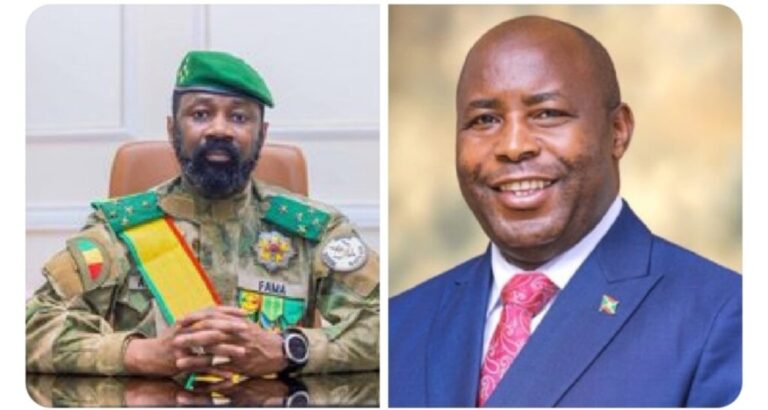
Burundian President Evariste Ndayishimiye, recently appointed as the African Union’s Special Envoy for the Sahel, held a telephone conversation Monday evening with the head of Mali’s transition, General Assimi Goïta.
The discussion focused on the regional situation, APA has learned. President Ndayishimiye, whose appointment was officially announced by the AU, described the exchange as “fruitful and friendly,” emphasizing it occurred “in a climate of mutual trust” and centered on “the situation in the Sahel.”
His designation by current African Union Chairman João Lourenço (President of Angola) is part of a broader rapprochement effort with the Sahelian member countries of the Confederation of Sahel States (AES) – Mali, Burkina Faso, and Niger. These nations, though suspended from the continental organization following coups d’état, are grappling with a major security crisis.
João Lourenço had previously engaged with Niger’s transitional president, General Abdourahamane Tiani, in early July and dispatched his Foreign Minister, Tete António, on a mission to the three Sahelian capitals in June to reignite dialogue. Angola has characterized the region’s situation as a “true continental emergency” demanding collective mobilization against terrorism.
Ndayishimiye’s mandate is to intensify contacts with transitional authorities, regional actors, civil society, and international partners. His goal is to “foster dialogue, build consensus, and promote comprehensive strategies toward lasting peace.” This approach aims to mend the divisions between the AU and the AES, particularly after the latter criticized their marginalization following exclusion from a 2025 AU summit under the presidency of Moussa Faki Mahamat.
This initiative also follows the recent appointment of Mamadou Tangara as the AU Commission’s Special Representative for Mali and the Sahel, based in Bamako. Concurrently, João Lourenço continues his broader mediation efforts, having recently contributed to the signing of a peace agreement between Rwanda and the DRC, further solidifying Angola’s ambition as a central player in African diplomacy.
AC/Sf/fss/abj/APA