





Presented by Egyptian diplomacy as a major driver of African integration, the Egypt–Libya–Chad corridor currently appears more as a strategic showcase than a clearly structured, operational economic project.
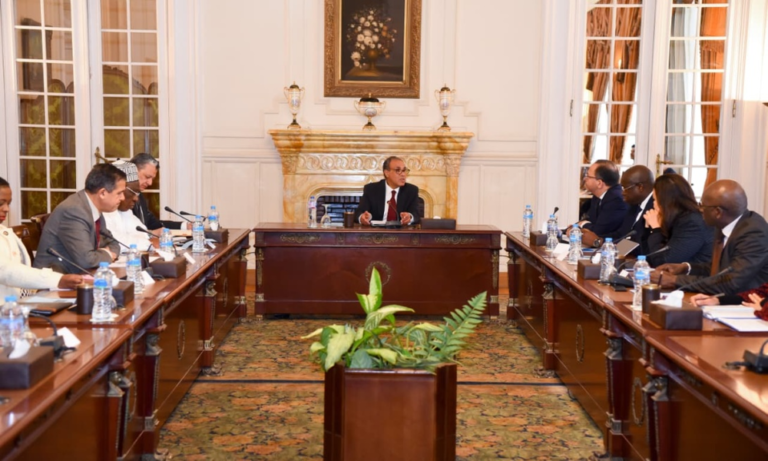
Egyptian Foreign Minister Badr Abdelatty reaffirmed on Saturday in Cairo that African economic integration remains a central pillar of the country’s policy toward the continent. Speaking to representatives of African Union organisations and offices accredited in Egypt, he highlighted the Egypt–Libya–Chad corridor as an “essential” project to strengthen continental connectivity and enhance cooperation between North and Central Africa.
The official narrative fits into a now well-established discourse in Cairo, which portrays large cross-border corridors as catalysts for regional development. Beyond the Egypt–Libya–Chad axis, the minister also cited the Cairo–Cape Town corridor and the Lake Victoria–Mediterranean Sea link, explicitly tying them to the objectives of the African Continental Free Trade Area (AfCFTA) and the African Union’s Agenda 2063.
However, beyond these statements of intent, few concrete details were provided on the actual progress of the Egypt–Libya–Chad corridor. No clear timeline, financing structure, or shared governance mechanisms were outlined, despite the fact that the proposed route crosses areas affected by persistent security instability, particularly in Libya and parts of the Sahel.
The repeated emphasis on economic integration contrasts with the absence of data on expected trade flows, local industrial spillovers, or how the corridor would connect with existing infrastructure in the countries concerned. At this stage, the project appears more as a tool of Egypt’s diplomatic outreach toward Central Africa than as a jointly designed regional initiative fully embraced by all partners.
The minister also stressed Egypt’s commitment to the principles of the African Union’s Constitutive Act, notably state sovereignty and non-interference. This emphasis comes at a time when major infrastructure projects also function as instruments of geopolitical influence, serving to consolidate strategic positions as much as to advance economic integration.
MK/ak/lb/as/APA