



The Senegalese capital is set to host a major international conference of the Economic Community of West African States (ECOWAS) Court of Justice from September 21 to 25, 2026, focusing on the future of community justice, the protection of fundamental rights and the emerging challenges posed by technology, particularly artificial intelligence.
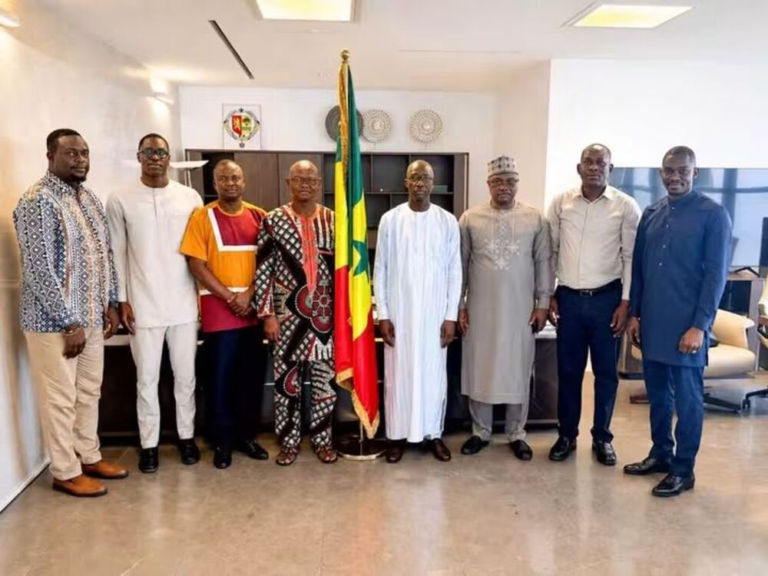
Preparations for the Dakar gathering on the future of community justice were at the centre of a meeting held on Friday, August 28, between Senegal’s Minister of Justice and Keeper of the Seals, Moussa Sarr, and an ECOWAS Court of Justice delegation led by its Chief Registrar, Dr Yaouza Ouro-Sama.
The mission to Dakar forms part of preparations for the international conference to be organised by the regional court in the Senegalese capital. Dakar was selected in consultation with the Senegalese authorities, reflecting the confidence placed in Senegal to support initiatives aimed at strengthening judicial cooperation and regional integration.
The conference is expected to bring together nearly 200 participants from across the judicial and academic spheres. Chief justices, bar association presidents, deans of law faculties, university professors and researchers are among those expected to attend the event.
Court of Justice faces new challenges
Held under the theme of the ECOWAS Court of Justice “at a crossroads,” the conference aims to foster in-depth reflection on the evolution of the regional court, its mandate and its future prospects within a West African region undergoing profound change.
Discussions are expected to focus on justice, innovation, human rights protection and regional integration. Particular attention will be given to new technologies and artificial intelligence, whose rapid development is creating new challenges for judicial systems, both in terms of court operations and the protection of rights and freedoms.
At the start of the meeting, the court’s delegation conveyed the institution’s appreciation to the Minister of Justice for Senegal’s continued support for its activities. Dr Yaouza Ouro-Sama explained that the delegation’s visit to Dakar was primarily intended to review preparations for the international conference with the Senegalese authorities.
Senegal reaffirms support for community justice
Receiving the delegation, Moussa Sarr welcomed the organisation of the conference and praised the choice of Senegal as host country. The minister also highlighted the relevance of the selected theme, saying it provides an opportunity for a thorough reflection on the current role, mandate and, above all, the future of the ECOWAS Court of Justice.
The Minister of Justice assured the delegation of the support of his ministry, working in coordination with the department responsible for foreign affairs, to help ensure the success of the event.
Beyond the logistical preparations, discussions underscored the strategic role of the ECOWAS Court of Justice in strengthening the rule of law in West Africa. Moussa Sarr noted the growing number of cases brought before the court by citizens on issues related to fundamental freedoms and political rights and liberties.
According to the minister, the dynamism demonstrated by the court in recent years confirms its importance within the community’s institutional architecture. Its ability to hear petitions concerning fundamental rights makes it a key instrument for regulation and citizen protection across the West African region.
Dakar, a hub for reflection on West African integration
Through the conference, Dakar is expected to become a forum for dialogue among judges, academics, lawyers and legal experts on the evolving nature of community justice.
Against a backdrop of significant institutional and political transformations across the region, the meeting is also expected to examine the role and future of regional courts in building a West African space founded on the rule of law, the protection of freedoms and cooperation among states.
The participation of nearly 200 prominent figures is expected to give the conference particular significance, providing ECOWAS with an opportunity to reflect on ways to strengthen its judicial mechanisms and better respond to citizens’ expectations regarding justice and fundamental rights.
TE/Sf/lb/as/APA