



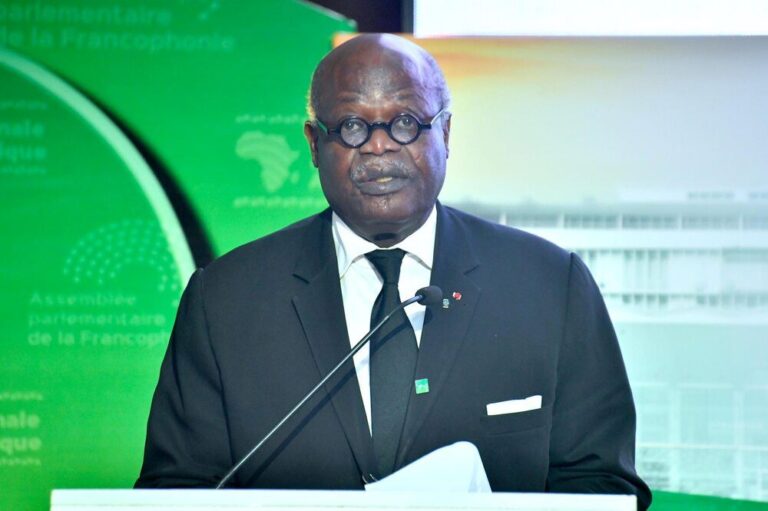
The President of the Parliamentary Assembly of the Francophonie (APF), Hilarion Etong, declared on Monday in Dakar that parliaments are an essential instrument for crisis prevention.
Etong said the role of parliaments in overseeing government action, participating in the development of security policies, guaranteeing respect for fundamental freedoms and the transparency of international commitments, and contributing to a concerted approach to defense and regional stability issues make them imperative in resolving crises.
“Our assemblies must be able to engage in dialogue when executives are at odds, maintain spaces for mediation when tensions escalate, and amplify the voice of the people when peace is threatened,” Mr. Etong declared at the opening of the 32nd APF Regional Assembly for Africa.
The meeting, held from May 18 to 20, 2026, in Dakar, focuses on two major themes: “International Crises and African Sovereignty: What Role for Parliaments in Strategic Governance and Collective Security?” “The situation in the Near and Middle East and the geopolitical realignment: what role for African parliaments in preserving stability and promoting lasting peace?” and “The situation in the Near and Middle East and the geopolitical realignment: what role for African parliaments in preserving stability and promoting lasting peace?”
Hilarion Etong, also First Vice-President of the National Assembly of Cameroon, emphasised the need to support African mediation efforts underway in several conflict zones across the continent.
“I am thinking in particular of initiatives aimed at fostering de-escalation and dialogue between the Democratic Republic of Congo and Rwanda, in a context that is particularly sensitive for the stability of the Great Lakes region. African facilitation initiatives and dialogue processes demonstrate that lasting solutions must first and foremost be driven by the continent’s own actors,” he stated.
The President of the APF also addressed the situation in Guinea-Bissau, where, according to him, “institutional dialogue and regional support remain essential for democratic consolidation and the
preservation of civil peace.” “Here again, parliamentary mediation will be useful,” he added.
He recalled that the APF Political Commission, which recently met in Siem Reap, Cambodia, had carefully examined these various political situations within the Francophone world, particularly in Africa.
According to Hilarion Etong, these examples demonstrate the need to strengthen African mechanisms for mediation, early warning, and preventive diplomacy, with increased involvement from parliaments.
“Africa needs collective security conceived by Africans themselves, respecting their priorities, realities, and aspirations,” he maintained. This ambition, he explained, requires strengthening
African inter-parliamentary cooperation as well as closer collaboration with regional and international organizations, notably the African Union, ECOWAS, the Economic Community of Central African States, and the International Organisation of the Francophonie.
In his view, contemporary crises are no longer solely military or diplomatic. “They directly affect societies, democratic institutions, economies and national cohesion. They therefore demand a strong, legitimate and representative political response from the people,” he declared.
He recalled that Africa has been facing numerous security challenges for several years: terrorism, violent extremism, internal conflicts, border tensions, transnational crime, cyber threats, information
manipulation, and foreign interference.
“Faced with these challenges, our states are legitimately seeking ways to strengthen their sovereignty. But sovereignty cannot be reduced to a political stance; it must be based on solid institutions, credible democratic governance, and a collective capacity for strategic foresight,” the Cameroonian parliamentarian argued.
Addressing the situation in the Middle East, Hilarion Etong asserted that the position of Francophone parliamentarians must remain clear: upholding international law, protecting civilian populations, rejecting terrorism, respecting the sovereignty of states, and constantly seeking negotiated political solutions.
“African parliaments have a unique voice to contribute to this international debate. Because our continent knows the price of conflict. Because it knows the lasting consequences of geopolitical
divisions.” “Because it carries a historical tradition of dialogue, mediation, and consensus-building,” he said.
He concluded: “Our region can contribute to restoring a diplomacy based on listening, balance, and international justice. In this spirit, the Francophone parliamentary diplomacy led by the APF is a
diplomacy of responsibility.”
TE/fss/as/APA