



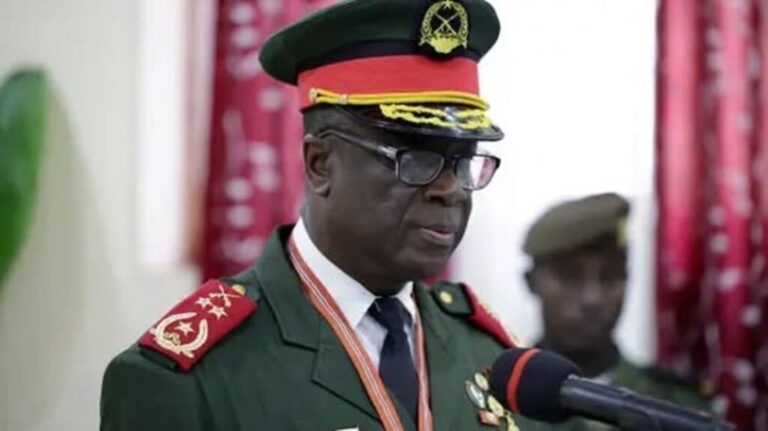
General Horta N’Tam over the weekend unveiled the composition of his transitional government, just days after the coup that interrupted the electoral process.
The military takeover occurred before the proclamation of results from the 23 November presidential election.
According to the presidential decree issued on 29 November, the transitional executive includes 23 ministers and five secretaries of state, who are to take office immediately.
The prime minister appointed the previous day is Ilídio Vieira Té, a former finance minister, member of the last government under President Umaro Sissoco Embaló, and campaign director for the coalition that backed the ousted president’s candidacy.
Among the key appointments, Carlos Pinto Pereira—who also served in the previous Camará government—was named Minister of Justice and Human Rights. General Mamasaliu Embaló will head the Ministry of Interior and Public Order, while another general, Stive Lassana Manssaly, was appointed Minister of National Defense.
Usna António Quadé becomes Minister of the Presidency of the Council of Ministers and Parliamentary Affairs; Carlos Nelson Sanó will oversee Territorial Administration and Local Governance; and Mamadú Mudjetaba Djaló takes charge of Economy, Planning and Regional Integration.
Other major portfolios were assigned to Florentino Mendes Pereira (Transport, Telecommunications and Digital Economy), José Carlos Esteves (Public Works, Housing and Urban Development), Celedónio Plácido Vieira (Natural Resources), Mário Muzante da Silva Loureiro (Energy), Amadu Uri Guissé (Agriculture and Rural Development), and Virgínia María da Cruz Godinho Pires Correia (Fisheries and Maritime Economy).
Social sectors will be overseen by Mamadú Badji (National Education, Higher Education and Scientific Research), Commodore Quinhin Nantote (Public Health), and Augusto Idrissa Embaló (Environment and Climate Action). Assucênia Nesbi Emília Seide Donate de Barros was appointed Minister of Public Administration, Labor and Social Security, while Juelma Cubala takes charge of Youth, Culture and Sports.
The ministers of Trade and Industry, Tourism and Handicrafts, and Social Communication will be Jaimentino Có, Catarina Raquel Mendonça Taborda, and Abduramane Turé respectively. Khady Florence Dabo Correia was appointed Minister of Women’s Affairs and Social Solidarity.
The five secretaries of state are Mamadú Baldé (Treasury), Elísio Gomes Sá (Budget and Fiscal Affairs), Fatumata Jau (International Cooperation and Communities), Principal Commissioner Salvador Soares (Public Order), and Rear Admiral Carlos Alfredo Mandughai (Veterans and Freedom Fighters).
The appointments come amid a climate of deep political instability. Guinea-Bissau, which has experienced nine successful or attempted coups since independence in 1974, continues to face major challenges in restoring the stability needed for development.
The new transitional cabinet—largely reshuffled compared with the previous government under Embaló—combines civilian and military figures, with a few notable holdovers such as Ilídio Vieira Té and Carlos Pinto Pereira.
Following his evacuation to Dakar with assistance from Senegalese authorities, ousted president Umaro Sissoco Embaló was reported by several media outlets to have arrived in Brazzaville on Saturday, although there has been no official confirmation from Congolese authorities.
AC/lb/as/APA