



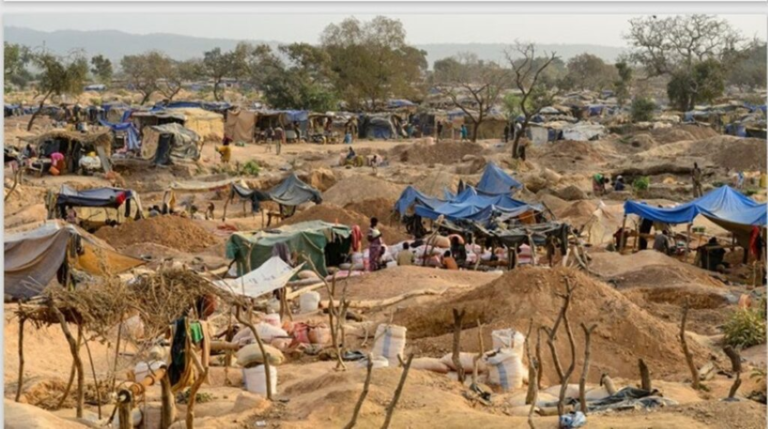
Operations to combat unregulated gold mining and the illegal export of gold are continuing in Guinea and are now being extended across the entire country, government ministries announced in a joint statement issued in Conakry on Monday.
The ministries of Justice and Human Rights, National Defence, Territorial Administration and Decentralisation, Security and Civil Protection, Environment and Sustainable Development, and Mines and Geology said defence and security forces would continue their operations professionally and in strict compliance with applicable laws and regulations.
The authorities said the operations were also intended to ensure the free movement of people and goods, protect the environment and safeguard human rights.
They warned that anyone involved in these activities, whether Guinean or foreign, would be arrested and prosecuted in accordance with national legislation.
Regional governors, prefects, sub-prefects, mayors, district and neighbourhood leaders, as well as all local authorities, have been called upon to support the defence and security forces deployed in the field.
This latest development marks a geographical expansion of the campaign launched by the Guinean authorities against illegal artisanal gold mining, which initially focused on the gold-producing region of Siguiri in the country’s north-east.
Crackdown launched in Siguiri
On October 29, local authorities in Siguiri announced the suspension of artisanal gold-mining activities before the government imposed a total ban on unregulated mining in the region on November 2.
The measure was intended in particular to put an end to unregulated mining practices and their impact on agricultural land, vegetation cover and water resources.
The authorities specifically banned the use of dredgers, the extraction and washing of minerals in riverbeds and along riverbanks, as well as the use of explosives, mercury, cyanide and other hazardous chemicals. They also announced the permanent deployment of defence and security forces and restricted gold purchases and trading to authorised buying offices.
The campaign led to the arrest of 1,263 people of seven different nationalities in Siguiri. On November 10, the figure had risen to 1,412 arrests after a further 149 people were detained in the prefectures of Kérouané and Siguiri. The authorities announced that those concerned would be brought before the courts.
The crackdown on illegal gold mining has also resulted in legal proceedings against administrative officials.
On November 18, the Court for the Repression of Economic and Financial Crimes (CRIEF) convicted 224 people, including 202 gold miners and 22 former territorial administrators, in a case involving clandestine gold mining in Siguiri.
The sentences imposed on the miners include three years in prison, a joint fine of 10 billion Guinean francs and, for the foreign nationals concerned, a 10-year ban on residing in Guinea.
The operations have also triggered tensions on the ground. The government reported 10 deaths and 13 injuries during clashes on November 11 in Balato, in the Kintinian prefecture, between protesters and defence and security forces tasked with enforcing the ban on illegal gold mining.
The crackdown has also prompted many foreign workers to leave gold-mining sites, particularly for Mali and Burkina Faso, raising humanitarian and diplomatic concerns across the sub-region.
By extending the operations nationwide, the Guinean authorities intend to broaden oversight of gold-mining activities and step up efforts to combat the illegal exploitation of the country’s mineral resources.
AC/lb/as/APA