



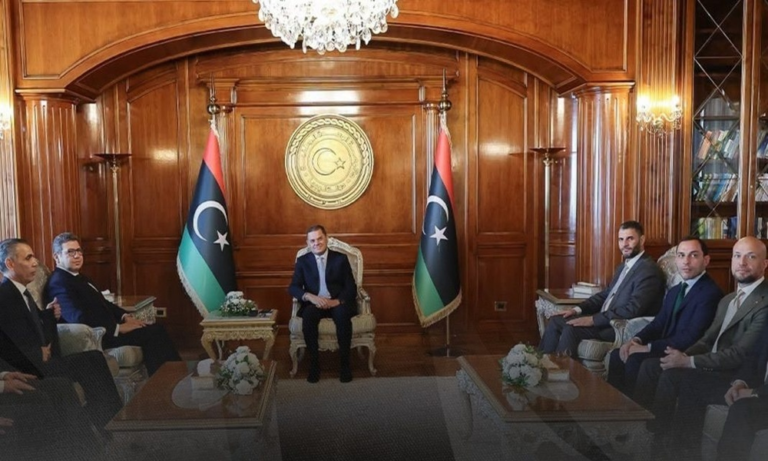
Abdul Hamid Dbeibah, head of Libya’s Government of National Unity (GNU), received Egypt’s intelligence chief, Hassan Rashad, in Tripoli on Monday.
Their talks covered political and security developments in Libya, bilateral cooperation and regional stability.
The Libyan situation was at the centre of another high-level exchange between Tripoli and Cairo.
Dbeibah received Maj. Gen. Hassan Rashad, head of Egypt’s General Intelligence Service, and an accompanying delegation at his offices in Tripoli on Monday.
According to the prime minister’s press office, the meeting was devoted to the latest political and security developments in Libya and to strengthening relations between the two countries.
Security cooperation took central stage. The two officials discussed ways to consolidate bilateral coordination mechanisms to address common challenges and protect the interests of both states.
Libya’s institutional and security stability, with the country still facing persistent political divisions, remains a major concern for its neighbors, foremost among them Egypt.
The talks also covered measures that could promote stability in the country while preserving its unity and sovereignty.
The statement from Dbeibah’s press office also said the two sides reviewed the regional situation and the need to coordinate efforts against shared security challenges.
No specific agreement or additional operational arrangement was announced after the meeting, however.
The meeting comes amid a diplomatic sequence marked by intensified contacts between Libyan and Egyptian officials.
A few days earlier, Rashad had received Libyan Deputy Defense Minister Abdul Salam al-Zubi and Saddam Haftar, deputy commander of the forces led by Khalifa Haftar, in Cairo. That meeting brought together representatives of two Libyan military camps operating in distinct political and security arrangements.
A visit to Tripoli by Egyptian Foreign Minister Badr Abdelatty a week earlier also showed Cairo’s desire to keep up close dialogue with the various components of the Libyan political landscape. The succession of exchanges illustrates the strategic importance Egypt attaches to its neighbour to the west, notably because of border, migration and security issues.
For Cairo, stabilising Libya is a national security imperative as well as a matter of regional influence.
For Tripoli, maintaining channels of dialogue with Egypt is a diplomatic lever in an environment marked by institutional fragmentation and persistent political rivalries.
It remains to be seen whether this intensification of contacts can lead to concrete progress toward bringing Libya’s disparate centres of power closer together.
MK/AK/Sf/lb/as/APA