





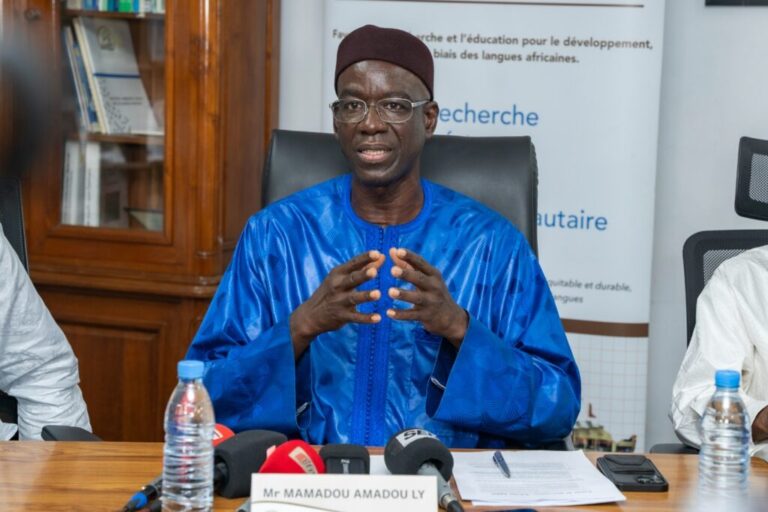
Mamadou Amadou Ly, Executive Director of the NGO Associates in Research and Education for Development (ARED) is the certified winner of the 2025 Yidan Prize for Education Development,
The Senegalese educator has become the first education development practitioner in West Africa to receive this prestigious international award.
Recognised for his inclusive, bilingual learning models, Ly reflects in this interview with APA on the significance of the award, the impact of his work across ARED’s partner countries, and his vision for an African education system rooted in local languages and innovation.
APA: You are the first laureate from West Africa to receive the 2025 Yidan Prize for Education Development. What does this recognition mean to you and to ARED?
LY: When I was informed that I had won the Yidan Prize — which is arguably the most prestigious award in the world for education, often compared to the Nobel Prize — my first thought went to the long journey that brought us here. This prize is, in many ways, a recognition of the collective effort of the entire ARED team, as well as of the communities and education ministries of Senegal, The Gambia, Mauritania, and twelve other Sahelian countries with which we collaborate.
For years, we have been working to promote quality education grounded in our national languages. Many doubted the relevance of this approach, but we have proven that it works. Today, this international recognition strengthens our conviction that Senegal can serve as a global model. It is, of course, a personal victory — but above all, it is a victory for Africa as a whole, demonstrating that African-led educational innovations can inspire the world.
This award also sends a strong message: that in a country like Senegal, meaningful work is being done that deserves international attention. It reminds us that we can produce exportable education models, whereas not long ago we used to look elsewhere for inspiration. Now, it is Africa’s turn to offer solutions to the world.
APA: Your NGO operates mainly in Senegal, Mauritania, and The Gambia. What tangible results have you observed in these countries through your educational models?
LY: In non-formal education, ARED operates in twelve countries, but in formal education, we focus primarily on Senegal, Mauritania, and The Gambia.
In Senegal, we are proud to have contributed to the reform introducing national languages in schools through a harmonised bilingual education model. This reform is based on ARED’s pilot programs — first in 14 classes, then 100, then 208 — before being adopted nationwide. Today, this model is implemented in 12 of the country’s 14 regions and 13 of its 16 school districts.
We have developed teaching materials in all subjects — language and communication, mathematics, and social education — from the elementary level up to sixth grade. All of these materials are made freely available to the Ministry of Education under an open license, because for us, knowledge is a common good.
In parallel, we created the “Ndaw Wune” program, which means “Success for All” in Pulaar, to help struggling students catch up. Between 2022 and 2024, the program reached nearly 20,000 students, achieving remarkable results: up to 74% success in reading and 100% in syllable recognition.
In Mauritania, ARED has been working for six years with the Ministry of Education and our partner Counterpart International. We introduced a bilingual Arabic-French approach based on phonics and structured pedagogy. The ministry has approved our textbooks for nationwide use — more than 127,000 students have already benefited, along with hundreds of trained teachers, inspectors, and ministry officials.
In The Gambia, inspired by Senegal’s experience, education authorities requested our support to launch a bilingual English-Wolof program in 55 schools, reaching 120 classes and about 4,000 students. We continue to provide technical and pedagogical support for its progressive rollout.
APA: Each country has its own educational realities. How do you tailor your approach to local community needs?
LY: The first step when entering a country is to build trust. We don’t come to impose a model but to work alongside local stakeholders. The key lies in close collaboration with ministries, inspectors, and teachers.
From the outset, we establish a technical working group composed of ministry officials and ARED experts. Together, we analyze needs, compare existing practices, and co-develop solutions. This approach fosters ownership and leadership — actors feel they are part of the change.
In Mauritania, for example, ministry officials have gradually taken over leadership of the project. Some teachers now proudly identify themselves as “ARED experts.” This shows that local integration has been successful and that transformation is emerging from within the system. We apply this participatory method everywhere we operate — from national to local levels — always ensuring that reform is locally driven.
APA: The Yidan Prize comes with significant funding. How do you plan to use these resources to strengthen your initiatives in the region?
LY: This award comes at a pivotal moment for ARED. It will allow us to consolidate our organisation, build stronger teams, and upgrade our digital tools. We also intend to develop a network of certified resource persons across countries to ensure the quality and sustainability of our interventions.
But this funding also opens the door to a new dimension: digital and linguistic innovation. We want to explore how digital technology and artificial intelligence can support African languages. Today, there is still no seamless machine translation between languages like Bambara, Mandinka, or Pulaar and French or English.
ARED possesses a vast linguistic corpus, accumulated over more than twenty years, in languages such as Wolof, Serer, Jola, Soninke, and Pulaar. Our goal is to mobilize linguists and educators to create multilingual datasets that will enable AI to learn these languages and integrate them into digital tools. This would open new pathways to knowledge and make technology a driver of linguistic and educational inclusion.
APA: Your approach places great emphasis on national languages and community involvement. Why are these two elements so crucial to your programs’ success?
LY: Because schools must once again belong to the community. Teaching in a child’s mother tongue allows for faster learning and strengthens the bond between school and family. National languages carry our values, stories, and cultural knowledge — they give meaning to learning.
When a child goes home and reads a story in Wolof or Pulaar, parents — often not formally educated — can understand and participate. This creates an intergenerational dialogue and restores the community’s active role in education. We want to move away from the notion that parents simply hand over their children to school and disengage. Education should not be a separate world; it should be an extension of the community. Using local languages helps rebuild that connection and recenter indigenous knowledge within the learning process.
APA: What is your vision for the future of literacy and inclusive education in Africa?
LY: Current national and international assessments still show low learning outcomes. Yet without a solid foundation in reading, writing, and numeracy, sustainable development is impossible. For me, teaching in national languages is the most powerful lever to improve education quality and strengthen human capital.
But this is not just a pedagogical issue — it’s also social and cultural. Adult literacy in their own language empowers individuals within their families and communities. It creates a collective movement where parents and children learn, communicate, and grow together.
This approach also helps reduce territorial disparities, bridge the urban-rural divide, and strengthen ties between cross-border communities that share the same languages. Pulaar, Mandinka, and Soninke thus become bridges for regional educational cooperation.
My ambition is to see this movement spread across the continent — an inclusive education, deeply rooted in our languages yet open to the world, capable of positioning Africa as a global hub of educational innovation.
ARD/ac/lb/as/APA