





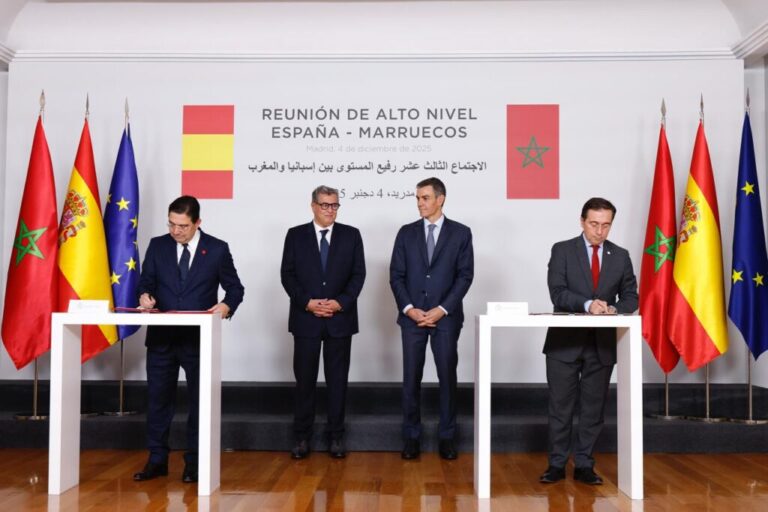
The Moroccan Minister of Foreign Affairs, Nasser Bourita, reaffirmed on Thursday the unique nature and depth of the “unprecedented” relations between the kingdom and Spain.
Burita’s remarks on bilateral cooperation between Morocco and Spain follow the 13th High-Level Meeting (HLM), held in Madrid, which concluded with the signing of several cooperation agreements.
Speaking in an interview granted to the Spanish agency EFE and relayed by Moroccan media, the minister stressed that the two countries now have a solid foundation to address, with “imaginative solutions,” the technical issues still being discussed. These notably include the management of the airspace over Morocco’s Western Sahara and the delimitation of maritime borders southwest of the Canary Islands.
Hailing a bilateral dynamic “unprecedented in the history of the two nations,” Bourita highlighted the progress made in security cooperation, the fight against terrorism, the management of migratory flows, as well as the intensification of economic exchanges and investments, which are now driven by “impressive figures.”
“Spain is Morocco’s leading economic partner. Security cooperation is exemplary, and cooperation on migration is effective,” he noted, emphasising that this relationship constitutes “a model between the two shores of the Mediterranean.”
This renewed atmosphere, he specified, reflects the joint commitment of King Mohammed VI and the Spanish Prime Minister, Pedro Sánchez, to elevate the bilateral partnership to the highest level.
He described the thirteenth HLM as a “successful event,” marked by the signing of 14 agreements and the identification of new areas for sectoral cooperation. He said Spain remains a “partner of reference” and a strategic interlocutor in all regional issues.
Addressing the question of the Western Sahara, the minister noted that “the constructive position adopted by Spain constituted an essential element in the positive evolution” of the partnership, while denouncing attempts by certain political spheres to sow discord. He opined that the “successful implementation” of bilateral commitments provides the clearest answer to these dissenting voices.
Regarding the issue of delimiting maritime borders and extending the kingdom’s exclusive economic zone in the Atlantic—a file that includes areas rich in cobalt, tellurium, and rare earths—the minister reiterated that it is a fundamental matter for “the entire Atlantic maritime area.”
AK/sf/lb/as/APA