





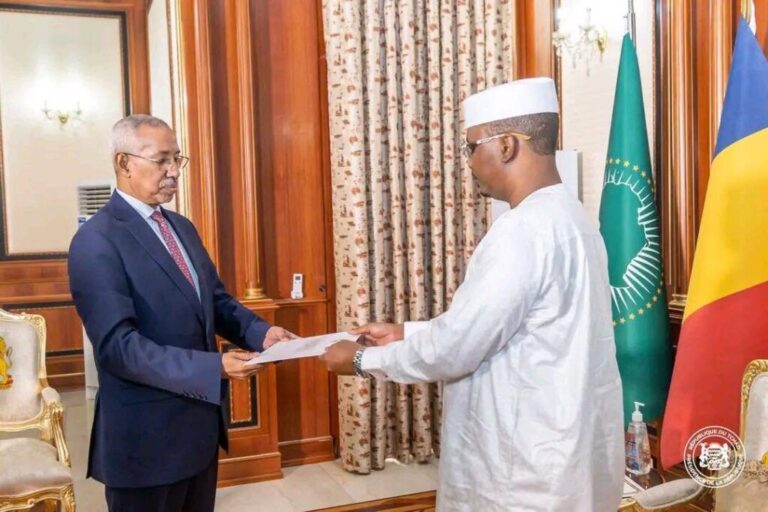
Chad hosted a Mauritanian envoy carrying a presidential message as part of a campaign to support a candidate for the presidency of the Organisation of Islamic Cooperation, following a similar visit to Bamako.
Chadian President Marshal Mahamat Idriss Deby Itno received Mauritanian Minister of Defence, Pensioners’ Affairs, and Children of Martyrs, General Hanana Ould Sidi, who was on a diplomatic mission to the sub-region.
The envoy delivered a message from Mauritanian President Mohamed Ould Cheikh El Ghazouani to his Chadian counterpart. At the heart of the discussions was Nouakchott’s request for support for the candidacy of Ismail Ould Cheikh Ahmed, former Minister of Foreign Affairs, for the position of Secretary General of the OIC.
This visit to Ndjamena is part of a diplomatic offensive aimed at mobilising African support for this candidacy.
According to the same source, Chadian and Mauritanian authorities also discussed prospects
for bilateral cooperation and regular consultations on multilateral issues.
The Chadian visit comes the day after a stop in Bamako, where the same envoy was received by the President of the Malian Transition, General Assimi Goita. There, he conveyed a similar message from the Mauritanian leader, as part of the same diplomatic effort.
Beyond this candidacy, the two sides also exchanged views on several issues of common interest in the Sahel-Saharan region, notably the fight against terrorism, in a context marked by security developments in northern Mali, the Sahel, and the Lake Chad Basin.
This Bamako-N’Djamena sequence illustrates a coordinated approach by Nouakchott aimed at strengthening its regional support ahead of upcoming deadlines within the OIC, while simultaneously consolidating its bilateral relations with several African capitals.
The Secretary-General of the Organization of Islamic Cooperation (OIC) is elected by the Council of Foreign Ministers for a five-year term, renewable once.
Candidates must be citizens of one of the 57 member states and selected based on competence, integrity, and experience.
The election adheres to the principles of rotation and equitable geographical distribution across the various regions of the Islamic world, ensuring equal opportunities for all member states.
The election process is an intergovernmental procedure specific to the organisation, conducted by the OIC’s foreign affairs body.
CA/ac/fss/as/APA