



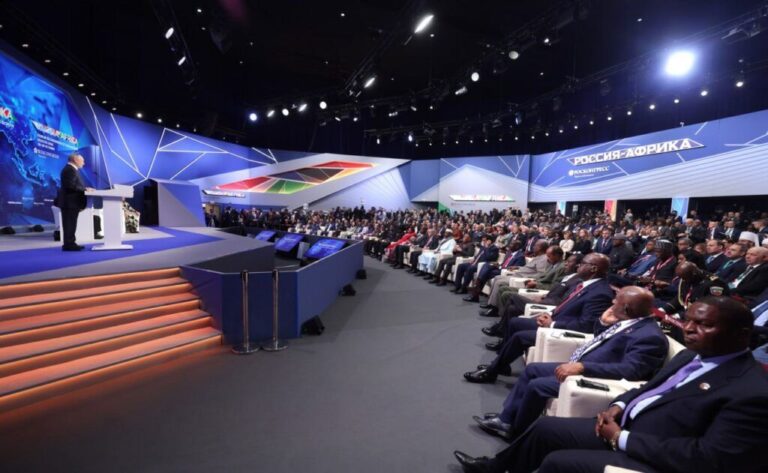
Russian President Vladimir Putin and his Foreign Minister, Sergey Lavrov, defended on Wednesday in Moscow the emergence of a more equitable world order, based on the sovereignty of states and better representation of countries in international affairs.
It was on the occasion of the third Russia-Africa Summit.
Speaking at the plenary session of the Russia-Africa Economic and Humanitarian Forum, Vladimir Putin affirmed that the multipolar world was becoming an irreversible reality.
“The era when the destiny of entire continents was determined by a select group of states is irrevocably coming to an end,” he said, advocating for a fairer international order, in which the voice of every country would be heard.
The Russian president notably highlighted the growing economic weight of emerging countries, indicating that BRICS members represented more than 40% of global gross domestic product over the last five years, compared to less than 30% for the G7 countries.
He also presented Africa as a growing hub of the global economy and politics, highlighting the desire of the continent’s countries to defend their sovereignty and freely choose their development
trajectory.
“Africans have an unwavering determination to defend their interests and the desire to shape their own future and choose their own development path,” he said.
Lavrov denounces Western pressure
For his part, Sergei Lavrov spoke during a working breakfast with his African counterparts, foreign ministers, organized on Wednesday on the sidelines of the summit.
The head of Russian diplomacy claimed that certain African partners had been pressured to dissuade them from traveling to Russia, citing political pressure, blackmail and threats of reductions in aid programs.
He also denounced the dissemination of false information, notably citing reports of an alleged plague epidemic in Russia, which would have aimed to discourage African participation.
Sergei Lavrov nevertheless welcomed the presence of the vast majority of African partners, despite what he described as Western manipulation.
The Russian minister estimated that Africa was experiencing a “second awakening”, after the wave of decolonisation of the 1960s, when the priority was political independence.
“Today, after having obtained their political independence, Africans want to ensure their economic, energy and financial sovereignty,” he said, adding that Russia would remain an ally of African countries in this process.
He also indicated that eight new Russian embassies had opened on the continent since the previous summit in 2023, bringing the number of Russian diplomatic representations in Africa to 48.
He also mentioned the interest of African partners in opening diplomatic missions in Moscow.
Economic and University Cooperation
Vladimir Putin, for his part, highlighted economic cooperation between Russia and African countries.
According to figures put forward by the Russian president, more than 40 African countries receive Russian grain and fertilizers, while Russian agricultural exports to the continent reached 13 million tonnes in the first nine months of 2026.
In the energy sector, more than 30 projects are underway in 16 African countries.
The Russian president also highlighted progress in academic cooperation, saying the number of African students in Russia has increased by 50% since 2020 to around 40,000. The quota of scholarships awarded to African students for the 2026-2027 academic year has been increased to 5,500, according to the data presented.
Discussing the continent’s demographic prospects, Vladimir Putin recalled United Nations projections according to which the African population could exceed 2.5 billion inhabitants by 2050, of which around 70% would be under 30 years old.
The third Russia-Africa Summit, held on October 28 and 29 in Moscow, aims to deepen cooperation between Russia and African countries in the political, security, economic, scientific,
technological and cultural fields.
The work should in particular lead to a final declaration and an action plan for the period 2027-2029.
AC/fss/as/APA