



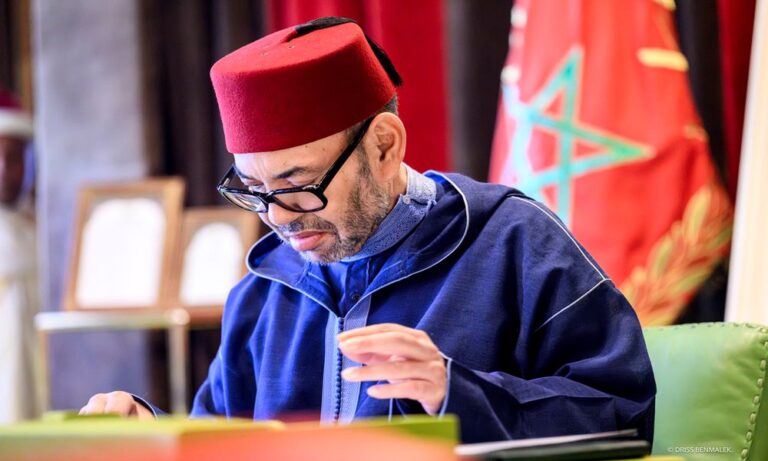
King Mohammed VI chaired a working session at the royal palace in Rabat on Wednesday focused on the progress of the Nador West Med (NWM) port and industrial complex.
It also focused on the expansion project for Tangiers Med – which includes the upcoming commencement of construction on the new Tangiers Med 3 port.
The first terminal of the Nador West port and industrial complex is set to become operational in the coming days.
During the meeting – which follows a series of previous working sessions chaired by the sovereign regarding the development of major national port projects, most notably the one held on January 28 – a presentation was delivered to the king by the chairman of the Supervisory Board of TMSA (Tangiers Med Special Agency) and the Board of Directors of Nador West Med.
The presentation covered the current status of both projects and the next phases of their development, according to a statement from the royal cabinet.
These two new initiatives are part of the King’s vision to equip Morocco with a high-performing port system, designed to bolster the nation’s competitiveness in the face of shifting global value chains.
The statement further notes that this ambition integrates national growth with regional development through the optimised allocation of public investment, the mobilisation of private capital, and the creation of employment opportunities.
The projects are also intended to deliver tangible benefits to local residents while anchoring value
creation within the respective regions.
The Nador West Med project complements the existing Tangiers Med complex and strengthens Morocco’s position as a logistics, industrial, and energy hub. By integrating port infrastructure with industrial, logistics, and energy platforms, the project has, to date, attracted 54 billion dirhams in public and private investment.
Its first container terminal, the initial phase of which will soon become operational, will eventually offer a capacity of 3.5 million containers.
A second terminal, with a capacity of 1.8 million containers, is set to enter service in April 2027. Together, these two terminals will represent 8 billion dirhams (€730 million) in private investment.
According to the presentation given to the sovereign, the energy component includes the commissioning of a hydrocarbon terminal – supported by a storage zone with a potential capacity of 4 million cubic metres – as well as a liquefied natural gas terminal capable of processing up to 5 billion cubic meters per year.
The facility will be further complemented by a terminal for solid bulk cargo and another for general cargo, the source added.
As for the industrial zone, which is already operational, it currently hosts one active factory, with three others under construction.
It is expected to create new business opportunities and avenues for professional integration. In the short term, the Nador West Med complex will generate 14,000 direct jobs and 20,000 indirect jobs.
This momentum is supported by the development of connecting infrastructure – notably the Selouane-NWM railway link, the Guercif-NWM motorway, and upgrades to the road network – designed to improve access to the surrounding regions, the presentation noted.
Meanwhile, the expansion project for Tangiers Med, also presented to the sovereign, will bolster the capacity of that port complex, with construction on “Tangiers Med 3” slated to begin shortly. Located to the west of Tangiers Med 2, this new port will feature 1,200 meters of quay, providing an additional capacity of 4.5 million containers per year, with an investment of 8 billion dirhams. A concession agreement has been signed with Maersk–APM, one of the world’s leading maritime
transport companies, for the development of a new container terminal.
This development coincides with the ongoing expansion of the passenger and roll-on/roll-off (Ro-Ro) port, and will facilitate the eastward expansion of Tangiers Med 2.
With the completion of these new projects, the Tangiers-Med port complex could reach a total capacity of 20 million containers, potentially placing it among the world’s top 10, the same source
notes.
At the conclusion of this working session, the king emphasised “the imperative that the economic and social benefits of these projects extend to all the provinces concerned, resulting in tangible
improvements for the local populations.”
In this context, “the sovereign called for the accelerated implementation of training programs tailored to the needs of emerging sectors, with the aim of fostering the professional integration of young people,” the royal cabinet’s statement highlights.
AK/fss/as/APA