



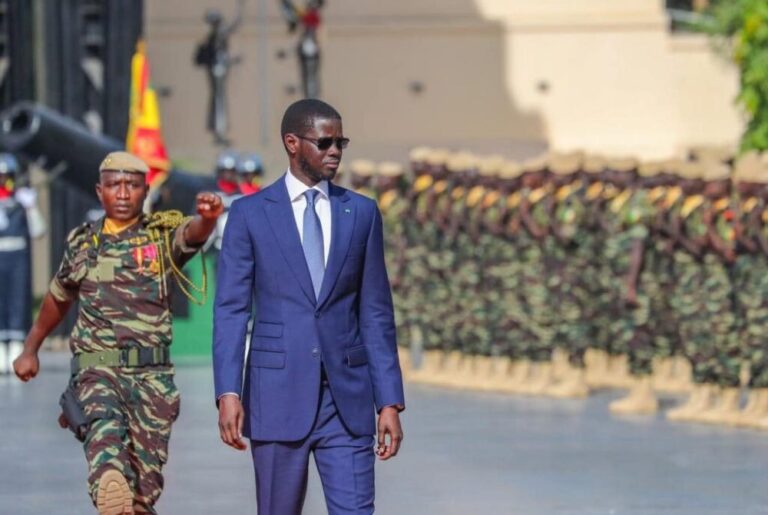
Senegalese President Bassirou Diomaye Faye Thursday called for strengthened military cooperation among West African nations in the face of persistent terrorism, the expansion of illicit trafficking, and emerging transnational threats.
He advocated for better coordination of regional capabilities and the development of African strategic autonomy.
The head of state made these remarks during the 23rd edition of Armed Forces Day, held at the Dial Diop camp in Dakar, under the theme: “The Armed Forces: Vectors for Sub-regional Integration and Collective Security.”
“Given this complex situation, it is time to mobilise regional energy and capabilities,” Bassirou Diomaye Faye declared, stressing the need to improve threat anticipation, situational awareness, and the operational readiness of response mechanisms.
He specifically highlighted the persistence of terrorism and violent extremism, the rising illicit trafficking, transnational organised crime, and the proliferation of instability hotspots – all of which
place mounting pressure on the states and populations of the sub-region.
According to the President, these challenges are compounded by the effects of climate change, tensions over resources, economic and social vulnerabilities, and emerging risks in the cyber and
information domains.
The Senegalese leader noted that armed groups and criminal networks exploit cross-border mobility, territorial vulnerabilities, and gaps in coordination between national security frameworks.
Reflecting on the historical ties between West African peoples, he pointed out that while borders define national sovereignty, they have not erased the deep-rooted family and economic relationships, nor the shared cultural heritage, that connect these nations. “This great proximity places a special responsibility upon us in the pursuit of peace and the prevention of crises,” he stated, recalling Senegal’s long-standing commitment – dating back to its independence – to
regional initiatives for conflict prevention and management.
Addressing the chiefs of staff of the armed forces from ECOWAS member states who were present at the ceremony, Bassirou Diomaye Faye lauded the “fraternity of arms” and the bonds of trust forged through decades of shared engagement.
He called for the strengthening of this cooperation by enhancing military capabilities, facilitating intelligence sharing, and organising joint exercises.
In his view, collective security also demands a sustained effort toward regional and continental strategic autonomy – a goal rooted in professional training, predictive capacity, well-suited equipment, and funding mechanisms commensurate with the missions entrusted to the armed forces.
In this context, he advocated for balanced international partnerships that respect the priorities of African states and foster the development of lasting, sustainable capabilities.
“The credibility of our collective security will be built through a patient, concerted effort to align political will, military expertise, and the resources actually available,” he declared.
Bassirou Diomaye Faye reaffirmed Senegal’s commitment to strengthening regional military cooperation, preserving the achievements of African integration, and developing instruments for peace and security.
The President – who also paid tribute to service members who fell in the line of duty and commended the courage of those wounded – reiterated his determination to continue the modernisation of the Senegalese armed forces, ensuring they are equipped with the means necessary to carry out their missions. He notably commended their contribution to ensuring security for the Youth Olympic Games (YOG) Dakar 2026, which Senegal has just hosted.
The ceremony also featured the naming of two graduating classes of officer cadets. The 58th class of the Military School of Health has been named after Medical Colonel Mady Oury Sylla, while the 45th class of the National School for Active-Duty Officers is named after Captain Andre Senghor.
AC/Sf/fss/as/APA