





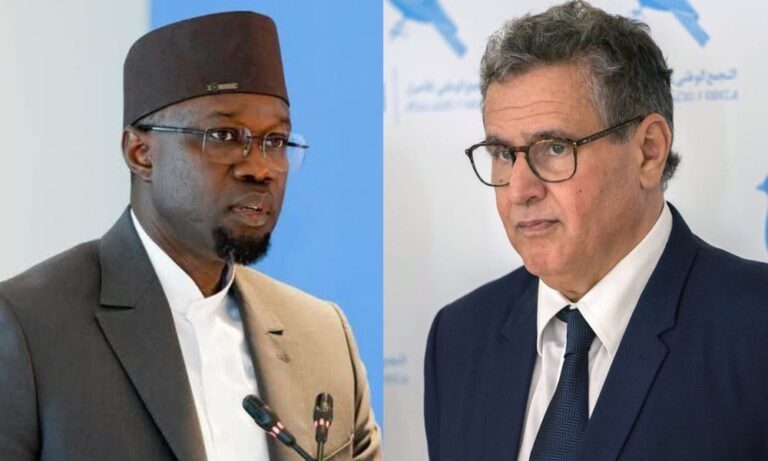
Senegalese Prime Minister Ousmane Sonko arrived in Rabat on Monday, January 26, 2026, for a high-stakes two-day visit focused on the 15th session of the Morocco-Senegal High Joint Partnership Commission.
This visit, his first since taking office in 2024, aims to revitalize a “thirteen-year-old” cooperative mechanism and further deepen a strategic partnership already defined by over 130 bilateral agreements.
While the primary agenda focuses on the Morocco-Senegal Economic Forum and strengthening ties in sectors such as agriculture, energy, and health, the visit is taking place under a shadow of sporting tension. Following Senegal’s 1-0 victory over Morocco in the 2025 Africa Cup of Nations (AFCON) final on January 18, 18 Senegalese fans remain in Moroccan custody facing hooliganism charges. Prime Minister Sonko and his Moroccan counterpart, Aziz Akhannouch, have both emphasized that the “fraternal” bond between the two nations transcends football, urging calm as legal proceedings for the detained fans continue.
Economically, the partnership is flourishing, with trade between the two nations seeing significant year-on-year growth. In 2024, Senegalese exports to Morocco rose by 26.2%, driven largely by fishery and agri-food products. Conversely, Moroccan imports to Senegal—primarily fertilizers, construction materials, and processed foods—reached 147 billion CFA francs ($234 million), maintaining Morocco’s position as Senegal’s top African supplier. Despite a trade deficit for Senegal of roughly 104.7 billion CFA francs, Moroccan foreign direct investment continues to peak, particularly in the banking, insurance, and pharmaceutical sectors.
Beyond trade, the commission is expected to explore new avenues for decentralized cooperation and digital transformation. Both leaders have reaffirmed their commitment to the “Royal Initiative for Atlantic Africa,” a project aimed at fostering shared prosperity along the continent’s western coast. As the two-day summit concludes, the focus remains on ensuring that the historical, religious, and economic foundations of the Dakar-Rabat axis remain a model for South-South cooperation on the continent.
AC/Sf/fss/abj/APA