





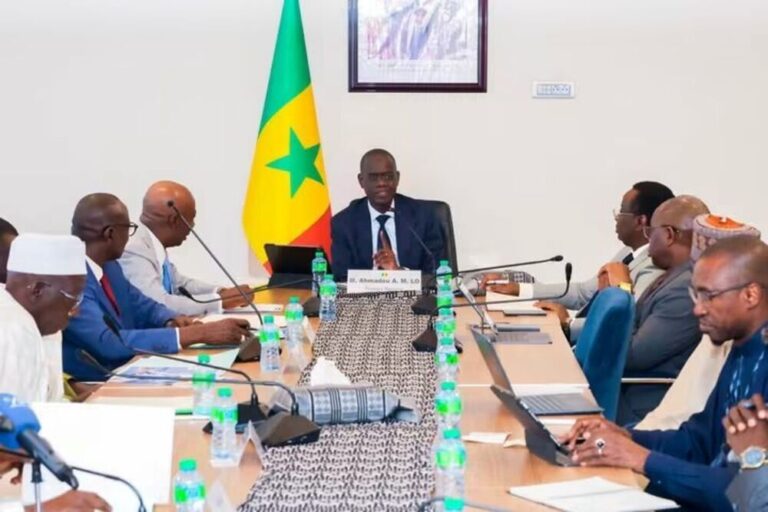
Senegalese Prime Minister Ahmadou Al Aminou Lo, on Thursday, called for national private sector stakeholders to play a central role in the structural transformation of the economy.
He made this appeal during a meeting in Dakar with employers’ associations and professional bodies, attended by several government ministers.
“The structural transformation of the Senegalese economy will not be achieved through the will of the State alone,” the PM stated, emphasising that realising the country’s economic ambitions
would also depend on the commitment of national enterprises.
According to Mr. Lo, the private sector must be placed at the heart of wealth and job creation, while the State must strengthen its role as a strategist, regulator, and facilitator of economic activity.
The meeting took place just days after the PM’s general policy statement, during which several strategic directions were announced regarding investment, industrialization, employment, and
improving purchasing power.
Notably, the PM reaffirmed the state’s commitment to continuing the settlement of its domestic debt. “The settlement of the domestic debt will be carried through to completion,” he assured,
addressing one of the primary concerns raised by businesses.
The government views the settlement of outstanding payments owed to economic operators as essential for restoring trust between the state and the private sector and for supporting corporate cash flow.
Regarding the business climate, the PM announced that the implementing regulations for the 2025 Investment Code and the new framework for public-private partnerships (PPPs) would be finalized
before the end of the year.
According to the government, these reforms are intended to enhance legal certainty for investors, improve the predictability of the business environment, and facilitate the mobilization of private
capital.
The private sector will also be involved in the preparation of several economic reforms. The General Tax Code and the General Customs Code are to be submitted to professional organizations for their input, while the framework bill on economic patriotism is being finalized.
At the same time, the government intends to accelerate the country’s industrialisation and increase local content in investments and major projects.
The aim is, in particular, to boost the participation of Senegalese companies in public procurement and in value chains linked to national resources.
This strategy also targets regional markets. Senegalese companies are encouraged to strengthen their presence within the West African Economic and Monetary Union (UEMOA), the Economic Community of West African States (ECOWAS), and the African Continental Free Trade Area (AfCFTA).
In his general policy statement, Ahmadou Al Aminou Lo set a goal of creating 1.5 million jobs by 2029. To achieve this target, the government is focusing on sectors such as agriculture, agro-processing, industry, fisheries, renewable energy, housing, and the cultural and creative industries.
The prime minister also aims to boost economic activity in rural areas. He advocates for organizing production in a way that shifts from seasonal work to more consistent, year-round economic activity.
Controlling the cost of living is another key focus of government action. Program contracts between the State and the private sector are to be developed for several strategic value chains, including cereals, bread, meat, fish, cooking oils, sugar, vegetables, and milk.
These mechanisms are designed to identify constraints affecting these various sectors and to find sustainable solutions to supply and pricing challenges.
The government also plans to expand storage capacity and strengthen market oversight. Thursday’s meeting thus signals the executive’s commitment to strengthening dialogue with the private sector and making productive investment a key driver of Senegal’s economic transformation.
Discussions are now expected to focus on the concrete implementation of these strategic directions, particularly regarding the settlement of domestic debt, business financing, access to public procurement, the improvement of the business climate, and the development of local
content.
TE/fss/as/APA