





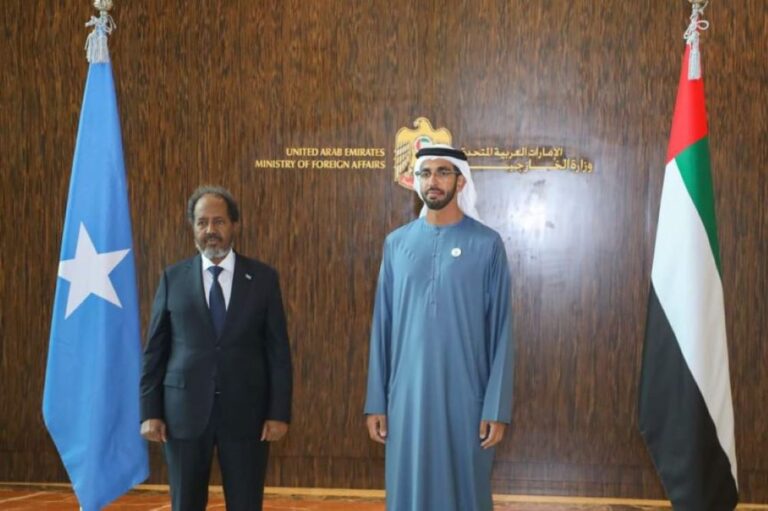
Relations between Somalia and the United Arab Emirates have turned south over the latter’s questionable position over the self-declared Republic of Somaliland weeks after it was recognised by Israel.
This sourness in relations has been building up for sometime but President Hassan Sheikh Mohamud’s address to the Somali nation on Monday has cleared any lingering doubts about the sense of estrangement that has now replaced the trust that was once warm between Mogadishu and Abu Dhabi.
President Mohamud declared that all bilateral cooperation agreements with the UAE have been immediately cancelled as Somalia said the Gulf state had violated its sovereignty through activities that sought to destroy the unity and territorial integrity of the country.
The Somali leader said good relations with the UAE is now a thing of the past after it bypassed federal Somalia as as an independent and sovereign nation, forcing officials in Mogadishu to make a decision on the apparent affront on its integrity as an internationally recognised country.
On paper this means that operations in the ports of Berbera, Bosaso, and Kismayo have been brought to a halt.
In reality, the federal government’s contested authority in eclaves such as Somaliland, Puntland and Jubalaand makes this impossible to be recognised much more enforced.
UAE personnel working under such projects are reportedly pulling out of Bosaso but others remain in Berbera which is in Somaliland where the authority of the Somali federal government is apparently non-existent on the ground.
Also cancelled are security and defense agreement between Somalia and UAE as do deals economic and infrastruture development.
However, these cancellations may just be in theory since semi-autonomous states such as Jubalaand and Puntland are insisting that their agreements with UAE cannot be overtured by the federal government in Mogadishu.
Puntland for example argued that the security deal it reached with the UAE is lawful while Somaliland as in the past has reacted defiantly, pointing out that its cooperation with the UAE will remain intact and not subjected to Mogadishu’s authority.
Foreign firms already in Somaliland such as the DP World said it would not leave.
It said in a statement that its port operation in the self-declared republic is fully invested in facilitating trade and will continue doing so for the foreseeable future.
Somalia and the UAE have not been on the best of terms since 2024 but the fallout from Israel’s recognition of Somaliland which Mogadishu still claims as its territory with backing from the international community, constituted the last nail in the coffin sealing their estrangement.
Mogadishu accuses the UAE of behind-the-scenes lobbying for the recognition of Somaliland in pursuit of its own geopolitical interests at the expense of Somalia’s territorial integrity.
The UAE has not responded to the allegations.
Israeli recognition had opened the way for Somaliland to become a signatory of the Abraham Accords, to which the UAE is also a signatory, effectively establishing full diplomatic relations with Israel, a country at the raw end of the wrath of Muslim-majority countries since the conflict in Gaza began in 2023.
UAE’s involvement with Israel following the latter’s recognition of Somaliland finds it at odds with Somalia whose federal authorities suspect it of ‘acting with double standard’, maintaining relations with them while ‘entertaining’ their geopolitical adversaries at the same time.
And then the controversy surrounding UAE facilitating the ferrying of fugitive Yemeni warlord and separatist Aidarous al-Zubaidi to exile through facilities inside its federal territory which was condemned by Mogadishu as a blantant violation of its sovereignty.
al-Zubaidi whose Southern Transitional Council wants a seperate independent state from Yemen, was ferried to Berbera port in Somaliland before being flown to the UAE capital Abu Dhabi from Mogadishu’s main airport in full protection by emirate officials.
Somalia’s state minister for foreign affairs Ali Omar said this was unacceptable and called on the international community to act.
Relations have been good as recently as in 2024 when President Mohamud attended a security conference called for more international backing of the federal government;s military campaign against al-Shabaab. He had called on Somalia’s international partners to help protect his country’s sovereignty.
With such relations going south, there seems to be growing fractures iwithin the international coalition against the insurgents and the fight to stop the disintegration of Somalia.
WN/as/APA