



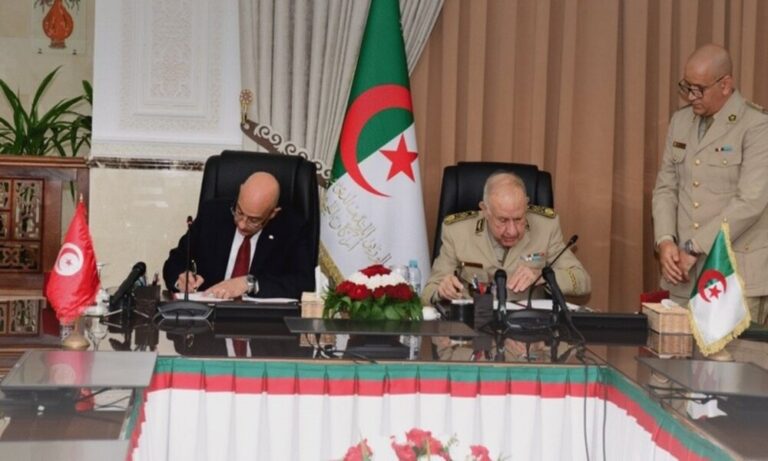
A growing rapproachent has been witnessed between Algiers and Tunis in recent years, culminating in a meeting between Algerian President Abdelmadjid Tebboune and Tunisia’s Defense Minister Khaled Sehili, who was accompanied by an official delegation.
The meeting, attended by the Chief of Staff of the Algerian People’s National Army (ANP), General Saïd Chanegriha, concluded with the signing of an intergovernmental military cooperation agreement between the two countries.
Described as a “strategic partnership,” the accord has nonetheless sparked debate over the increasing imbalance between Algiers and Tunis in the management of regional security.
According to an official communiqué, talks focused on coordinating efforts against cross-border threats and the need for permanent consultation. General Chanegriha emphasised the “exceptional nature” of bilateral relations and Algeria’s determination to strengthen cooperation across all areas of defense.
Minister Sehili, for his part, praised Algeria’s “constant solidarity,” without elaborating on the specific content or scope of the agreement.
Although details of the new defense accord have not been disclosed, it continues a pattern in which Algeria sets the pace of the relationship. In recent months, Algiers has multiplied its gestures of influence toward Tunis—through equipment deliveries, enhanced security coordination, and intelligence sharing along border areas. This dynamic reinforces Algeria’s dominant military position in the central Maghreb, while deepening Tunisia’s dependence in the face of institutional and economic fragility.
Minister Sehili’s visit comes as Tunisia seeks to diversify its partnerships, particularly with Italy and the United States, in an effort to reduce its strategic vulnerability. However, the growing alignment with Algeria may narrow its room for manoeuvre, especially on regional security issues where Algiers’s positions increasingly set the tone.
Algeria appears intent on consolidating a Maghreb-wide security axis under its leadership, amid shifting regional balances.
By publicly showcasing closer military ties with Tunis, Algiers is sending a clear message to neighbours and partners—including Morocco and France—that it remains the uncontested military power in the Maghreb.
For Tunisia, this rapprochement seems more a matter of necessity than strategic choice, as the country grapples with economic hardship and relative diplomatic isolation.
MK/lb/as/APA