



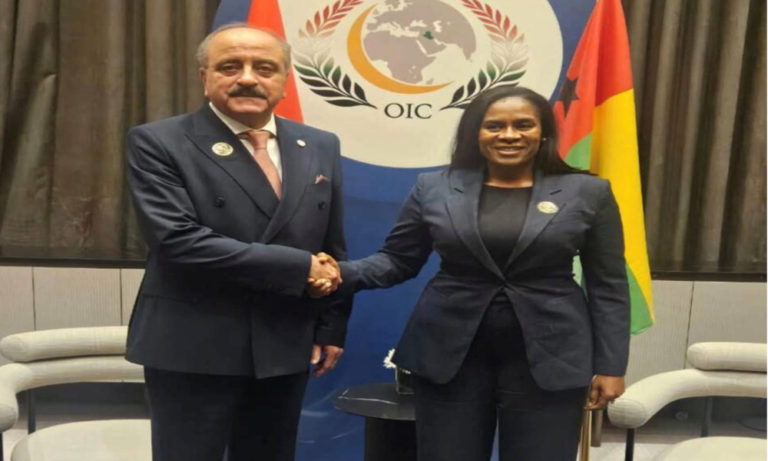
Tunisia and Guinea-Bissau have agreed to encourage trade and joint investments, while emphasising the implementation of existing bilateral accords.
The two countries intend to strengthen cooperation in higher education, scientific research, vocational training, and trade.
This commitment was expressed during a meeting between their respective foreign ministers, held on the sidelines of the 52nd session of the Council of Foreign Ministers of the Organization of
Islamic Cooperation (OIC), which took place on October 17-18 in Baghdad, Iraq.
Tunisia’s Minister of Foreign Affairs, Migration, and Tunisians Abroad, Mohamed Ali Nafti, and his counterpart from Guinea-Bissau – the Minister of Foreign Affairs, International Cooperation, and
Communities – examined prospects for developing bilateral relations.
Their talks focused on ways to enhance institutional exchanges and provide fresh momentum to partnerships between the two nations.
In the academic sphere, both officials highlighted the value of increasing the exchange of expertise between educational institutions, promoting student mobility, and facilitating access for students from Guinea-Bissau to Tunisian universities.
The potential offered by scholarship programs was also discussed, with the aim of supporting
educational pathways and strengthening ties between academic institutions.
Economic cooperation was another key focus of the talks. The two ministers agreed to promote trade and joint investments, while stressing the importance of implementing existing bilateral
agreements.
They also called for greater participation by Tunisian and Bissau-Guinean economic operators in forums, trade fairs, and meetings dedicated to commerce and investment, in order to foster
business-to-business contacts and raise awareness of available business opportunities.
On this occasion, Mohamed Ali Nafti highlighted Tunisia’s efforts to attract African investment and foster partnerships between businesses across the continent. He underscored the need to strengthen African economic integration and intra-African investment, as a complement to the ongoing dialogue between members of the African Union.
This meeting is part of a broader effort by Tunis to diversify its African partnerships.
While the directions discussed offer potential in the fields of training and trade, their realisation will depend primarily on the implementation of existing agreements, the identification of joint projects, and the mobilisation of economic and academic stakeholders from both countries.
MK/AK/Sf/fss/as/APA