



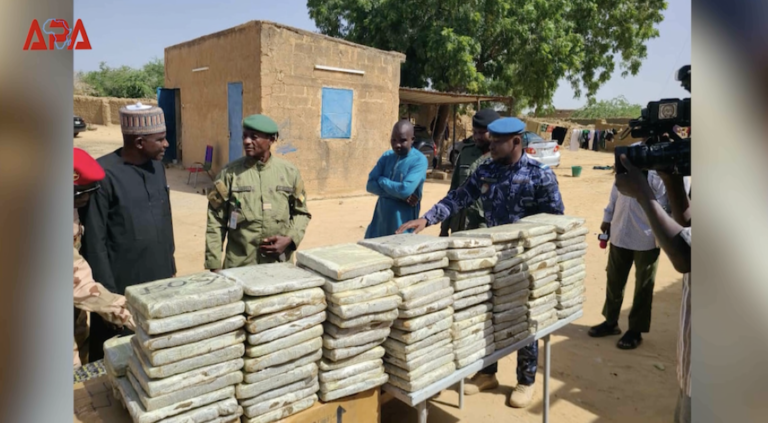
From multi-tonne cocaine seizures to interceptions of cannabis and synthetic drugs, West Africa continues to face trafficking routes linking Latin America, Africa’s Atlantic coast, the Sahel and European markets.
Operations reported in Senegal, Nigeria, Sierra Leone and Mali, alongside regional warnings about opioids and synthetic substances, highlight the scale and diversification of the phenomenon, APA has observed.
In Senegal, successive cocaine seizures underscore the persistence of trafficking flows along road corridors and in border areas. On June 15, 2026, customs officers intercepted 970.6 kilograms of cocaine along the Koumpentoum–Koungheul road near Ida Mouride.
The consignment, divided into 844 packages, was concealed in a compartment built inside a truck coming from a neighbouring country. Customs authorities estimated its value at more than CFAF 58.2 billion, or approximately $103 million. An investigation was opened to trace the supply chain and identify those responsible.
The operation was part of a series of major interceptions. In August 2025, 643 kilograms of cocaine were seized in Rufisque, followed by 272.25 kilograms in Kalifourou, in the Kolda region, in September and another 115 kilograms at the same border post in October. In November 2024, 235 kilograms had also been intercepted in Koungheul. Between March and November of that year, customs officers seized 2.114 tonnes of cocaine along the Dakar–Kidira corridor.
Operations are continuing along other routes. On September 23, 2026, customs officers seized 1.5 kilograms of cocaine from a bus passenger near Kénioto, along the Kédougou–Saraya road.
A few months earlier, the dismantling of a suspected international trafficking network in Dakar had led to the arrest of five Nigerian nationals and the seizure of 81 grams of cocaine in the areas of Grand Yoff, Mamelles, Ngor and Almadies.
Cannabis trafficking is another focus of Senegal’s anti-drug efforts. On January 30, 2026, police announced the seizure of 120 kilograms of cannabis on Tripano beach in Mbour, following intelligence indicating that a pirogue was about to land a shipment. The boat had left the area before law enforcement officers arrived. Investigations were expected to identify the owners of the consignment and members of the crew.
In Casamance, a military operation led to the seizure of six tonnes of cannabis in May 2026, while other interventions targeted hashish, MDMA and medicines diverted from their intended use. These cases show that Senegalese law enforcement agencies are confronting several categories of drugs and trafficking methods involving both land and sea routes.
In Nigeria, operations by the National Drug Law Enforcement Agency (NDLEA) also illustrate the scale of trafficking flows. On May 9, 2026, authorities discovered 2.326 tonnes of “Canadian Loud”, a high-potency cannabis variety, in a villa in the Lekki district of Lagos.
Four days later, more than 4.1 tonnes of the same substance were intercepted at Tincan Island Port. Authorities valued the shipment at approximately $7.6 million. It had been concealed inside imported Canadian vehicles loaded into a shipping container.
The shipment’s route illustrates the international dimension of the trade. The container left Toronto on March 28, 2026, travelled by rail to Montreal, then passed through Morocco’s Tanger Med port before arriving in Lagos on May 9. The operation involved anti-drug agencies, Nigerian Customs and several international partners, including the US Drug Enforcement Administration and the Royal Canadian Mounted Police.
In August 2026, the NDLEA also announced that it had seized more than three tonnes of drugs during a week of operations across several Nigerian states. Among those arrested was a Nigerian man detained at Enugu International Airport after swallowing 98 cocaine capsules weighing a total of 1.51 kilograms. He was preparing to board a flight to Italy via Addis Ababa and France.
Nigerian authorities have also reported convictions of traffickers and the destruction of seized drug stocks. These operations cover maritime import routes, air transport, domestic distribution and attempted exports.
Sierra Leone, meanwhile, features in analyses of maritime routes linking West Africa to Europe. A study by the Global Initiative Against Transnational Organized Crime (GI-TOC), published in June 2026, examined the seizure of 30.2 tonnes of cocaine aboard the cargo ship Arconian, which was intercepted by Spain’s Guardia Civil on May 1.
According to the study, investigators believe the shipment was probably loaded in Sierra Leone before being transported towards Europe. The report describes a method involving the storage of cargo along the West African coast, its transport aboard cargo ships to remote maritime areas, and its subsequent transfer to speedboats intended to bring the drugs closer to European markets.
Researchers identified at least eight voyages with similar characteristics between 2024 and 2026. Some vessels reportedly travelled between Freetown and North Africa, spending long periods waiting at sea and changing flags. The report also points to suspected links between some of the vessels under investigation and the network of Dutch trafficker Jos Leijdekkers, while noting that some investigations are still ongoing.
Guinea-Bissau has also featured in international drug-trafficking cases, particularly through judicial proceedings and extraditions. In April 2025, four people suspected of drug trafficking were extradited to the United States. The case highlights the importance of judicial cooperation in addressing networks operating across multiple jurisdictions.
In the Sahel, cocaine trafficking is also being examined through the lens of overland corridors and criminal economies. An article published in August 2026 on the Mali–Niger–Libya route explored transit networks and the links between illicit trade, criminal networks and war economies. These routes cross areas where border-control capacity, the presence of armed groups and the movement of goods pose major security challenges.
In Mali, seizures have involved both cannabis and cocaine. In May 2025, 12 kilograms of cocaine, valued at CFAF 240 million, were intercepted at Bamako airport. In April 2026, another operation led to the seizure of 82 cannabis balls in Hèrèmakono, along a border route linking Mali and Burkina Faso.
In Burkina Faso, anti-drug operations have also included seizures of synthetic substances. In June 2026, the relevant authorities announced the seizure and destruction of a batch of amphetamines. These cases add to investigations involving cannabis, diverted medicines and cross-border trafficking routes.
Beyond seizures, synthetic drug markets are becoming an increasing concern. In a study published in March 2026, the GI-TOC described a transformation of West African drug markets marked by the proliferation of opioids and synthetic substances, as well as the emergence of new criminal actors. The report highlights the difficulties states face in adapting law enforcement and public health systems to substances whose composition and distribution channels are changing rapidly.
The Economic Community of West African States (ECOWAS) has also raised concerns about developments in these markets. In July 2026, Daniel Amankwa, the organisation’s drug prevention and control programme official, said cocaine-related arrests and seizures in the region had doubled in 2024. Early indications suggested that the trend had continued in 2025, although the data were not yet final.
The regional official also referred to the diversion of medicines and the circulation of high-dose tramadol tablets, with some formulations reaching 200 to 500 milligrams, compared with the commonly cited 50-milligram dosage. ECOWAS advocates a response combining prevention, education, law enforcement and access to treatment for people experiencing drug-use disorders.
International data place these developments in a broader context. The United Nations Office on Drugs and Crime’s (UNODC) World Drug Report 2025 estimates that global cocaine production reached a record 3,665 tonnes in 2023. The agency identifies West Africa as a significant transit region for cocaine bound for Europe, while also noting rising demand and growing healthcare needs associated with drug use.
A GI-TOC study published in September 2025 identifies port infrastructure in Senegal, Guinea-Bissau and Sierra Leone as points used by international networks to store, containerise and redistribute cocaine. It also describes links between Western Balkan networks and the Brazilian criminal group Primeiro Comando da Capital (PCC).
The study estimates that West Africa could account for up to 50% of the cocaine consumed in Europe by 2030 passing through the region. This is the organisation’s projection, not a measured proportion for the current year.
For several decades, West Africa has served as a transit region for cocaine shipments originating mainly in Latin America and destined, in particular, for the European market.
Maritime routes, Sahelian road corridors and land borders are used depending on the drugs involved and the networks operating them.
National authorities are stepping up seizures, investigations and international cooperation, while regional and international organisations stress the need to combine efforts to suppress trafficking with financial-flow monitoring, prevention and healthcare. However, reported seizures alone cannot measure the overall size of the illicit market or establish a uniform trend across all countries in the region.
AC/lb/as/APA