



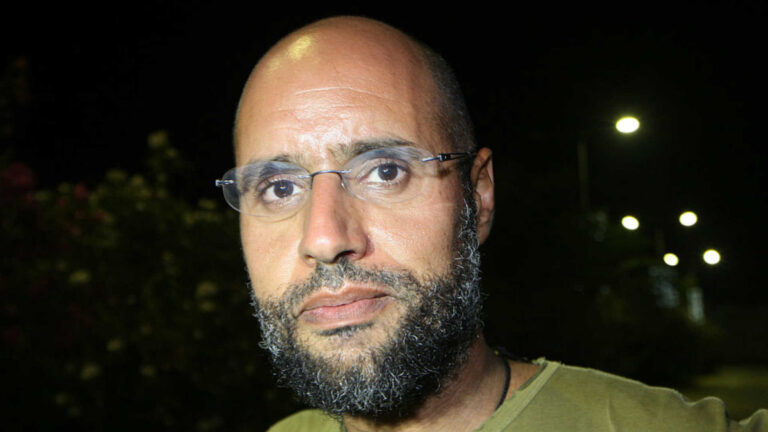
At just 53, Saif al-Islam Gaddafi’s life has been brutally brought to an abrupt end, cut short by bullets from four assassins who had ambushed him at his home in Zintan in western Libya on Tuesday.
But what does his death mean for Libya’s future as the country continues to grapple with instability 15 years after the overthrow and assassination of his father Muammar Gaddafi?
Nothing is known about his assassins but some observers wth sangune views hold that they may have removed a human stumbling bloc to the future of holding elections and setting the country back on track.
Until the upheaval which upended the Gaddafi political dynasty, Saif was widely tipped to be his father’s successor to lead Libya and continue the family’s political hegemon in the tradition seen elsewhere in Africa where power had transitioned from father to son.
But what could not be missed is that he was a divisive figure in Libyan politics. While instantly recognisable, he command adulation and attract alienation at the same time. He became the genial face of the Gaddafi regime in the 1990s and early 2000s when he flirted with the West where he was widely viewed as a promising politician amenable to reforms who could help turn Libya away from its tyrannical reputation under his father. However all that about him changed when the Arab Spring came and Libyans took to the streets, demanding regime change.
Wanted by the International Criminal Court for his role in the bloody repression of Libya’s own chapter of the Arab Spring which had taken over the Middle East in 2010, Saif was a hunted man internationally and nationally. However, the ICC never got to pull off his extradition and trial. It was left to the local Libyan authorities to hold a hastily arranged trial before jailing him for six years. He was atoning for the erstwhile regime’s bloody, heavyhanded put down of the uprising which eventually culminated in the downfall of Gaddafi senior.
He immersed himself in local Libyan politics after his amnesty as supporters of his father saw a chance to live their pipe dream of hoisting once again a Gaddafi to the top end of Libya’s political patrimony. Factional rule divided Libya into a west-east administrative rivalry, with the internationally recognised government based in Tripoli and another backed by other world powers headquartered in Benghazi. Although open conflict has been few and far between, both sides have been living through a stalemate which meant little progress in reforms to hold elections and return the country to normalcy. Gaddafi supporters had pointed to how far Libya had distingetrated as a consequence of his ouster and saw his son Saif as their saving grace.
Saif had announced his candidacy when elections were slated for 2021 but was eventually postponed due to the precarious political environment which by and large remains unpredictable on the eve of his assassination.
Emadeddin Badi, a senior fellow with the Middle East Programs at the Atlantic Council tells AFP that the death of Gaddafi’s most prominent son may turn him into a martyr for segments of the Libyan population still nostalgic about his father’s days as the country’s leader when Libya enjoyed the benefit of its oil, boasting being among some of the most progressive nations of the world in the 1980s through to the 2000s. Badi says the removal of Gadaffi junior will posibly shift ”the electoral dynamics by removing a major obstacle to presidential elections”.
Many Saif critics and detractors opposed his inclusion on the list of candidates for the country’s top job, condemning any talk of him ruling Libya as an unwholesome idea to conserve and preserve dynastic politics.
Some old enough say it harkens back to the days of King Idris before his overthrow by Muamar Gaddafi in a 1969 military coup. Gaddafi had denounced the deposed monarchy as lacking in nationalist character, weak, inept and corrupt.
WN/as/APA