



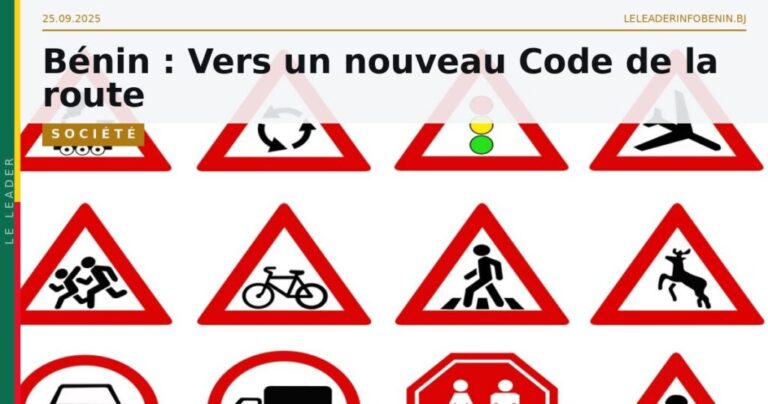
The National Assembly of Benin had on Monday adopted Law No. 2026-18, the new Highway Code, marking a major milestone in the modernisation of the country’s road regulations, the National Road Safety Centre (CNSR) announced in a statement.
This new legislation, comprising 122 articles, updates a legal framework that had previously relied primarily on a general decree dating back to 1956 – a framework that is no longer suited to the realities of modern mobility.
The primary objectives of the new legislation are to enhance user safety, foster greater driver accountability, and reduce the number of fatal accidents on Beninese roads.
According to the data cited in the CNSR statement, approximately 3,200 people lose their lives in traffic accidents in Benin every year – an average of nearly nine deaths per day.
Among the key innovations in this law is the classification of 14 serious behaviours as criminal road offenses.
These include driving with a blood alcohol concentration of 0.8 g/l or higher, driving under the influence of narcotics, exceeding the speed limit by at least 50 km/h, driving without a license or insurance and fleeing the scene of an accident (hit-and-run).
The legislation also provides for stricter enforcement and tougher penalties, including mandatory testing following an accident and the immediate revocation of a driver’s license in the most severe cases.
In the area of prevention, the law mandates the use of helmets for both drivers and passengers of two-wheeled vehicles, as well as the use of seat belts in motor vehicles.
It also requires the use of appropriate child safety restraint systems and prohibits the use of mobile phones while driving.
Furthermore, the new legislation places special emphasis on vulnerable road users – such as pedestrians – while also strengthening protections for individuals who provide assistance to accident victims. It also extends vehicle registration requirements to motor vehicles and introduces road safety education into school and university curricula.
The CNSR has hailed this as a major step forward for road safety in Benin, expressing its gratitude to the President of the National Assembly, the Law Commission and all the members of Parliament.
It also highlighted the role played by the government – specifically the Ministry of Living Environment and Transport, responsible for Sustainable Development – in championing the legislation.
The adoption of this law follows a consultative process with the national legislature, which notably included an introductory seminar for members of parliament held on October 20, 2026, in Agoue.
The text must now complete its institutional journey toward formal promulgation, followed by the drafting and adoption of the implementing regulations necessary for its execution.
The CNSR intends to support this new phase through awareness-raising and prevention initiatives aimed at road users, as part of its “AGIR” (Act) framework – an initiative focused on fostering driver accountability and achieving a lasting shift in behaviour on the road.
In the view of the CNSR, adherence to traffic rules is a vital tool for saving lives and ensuring long-term improvements to road safety in Benin.
TE/fss/gik/APA