



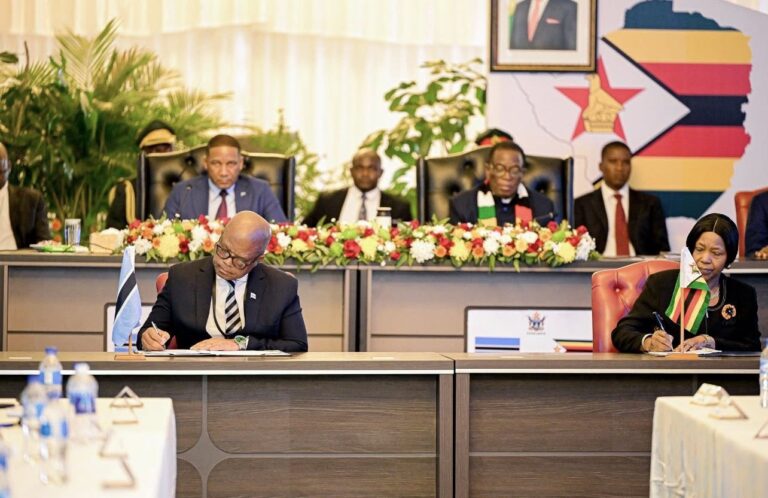
Botswana and Zimbabwe have signed 10 memorandums of understanding at their Bi‑National Commission (BNC), sealing new cooperation agreements spanning defence, policing, immigration, air search‑and‑rescue, trade and investment promotion, and cultural collaboration.
The agreements were concluded during the latest session of the BNC, the high‑level platform that guides bilateral cooperation between the two neighbours.
Co‑chairing the meeting, Botswana’s President Duma Boko said the BNC remained central to strengthening practical collaboration and deepening long‑standing political, economic and historical ties.
He urged both countries to focus on complementarity rather than competition, highlighting shared priorities in agriculture, health, energy, infrastructure, tourism, defence and regional security.
Boko also raised concern over the rise of synthetic drugs in the region, calling for stronger cross‑border coordination and harmonised policies to combat emerging threats.
The 10 agreements signed include cooperation on defence and training exchanges, policing to combat livestock theft and cross‑border crime, immigration management, prison and correctional services, transfer of sentenced persons, aeronautical search‑and‑rescue coordination, civil aviation accident investigations, support for cooperatives and small businesses, trade and investment promotion, and collaboration on the Museum of African Liberation.
The BNC, established to streamline bilateral cooperation at the highest political level, has become the main mechanism through which the two countries review progress on joint programmes and identify new areas of partnership.
It builds on decades of close relations rooted in liberation‑era solidarity and shared regional interests.
Boko said the latest agreements should translate into tangible improvements for citizens, stressing that both countries are “rising together towards shared prosperity and sustainable development.”
Officials from both sides said the new MoUs are expected to accelerate implementation of joint projects and strengthen coordination across key sectors.
JN/APA