



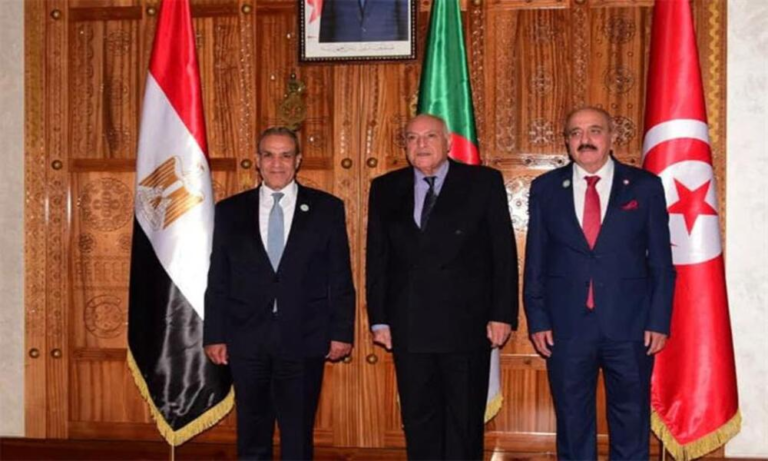
Egyptian Foreign Minister Badr Abdelatty has stressed the need to preserve the unity and sovereignty of Libyan territory, saying Libya’s security is an intrinsic extension of Egyptian and Arab national security.
Abdelatty was speaking on Sunday at a meeting in Algiers of the trilateral mechanism of Libya’s neighbouring countries, which also includes Algeria and Tunisia.
The minister held talks on Sunday, October 25, in Algiers with his Algerian counterpart, Ahmed Attaf, and Tunisian counterpart, Mohamed Ali Nafti, at a meeting aimed at strengthening coordination and consultation among the three countries to help find a consensual, inclusive, Libyan-led political solution based on dialogue among the various Libyan parties.
“The discussions focused mainly on coordinating the positions of the directly neighbouring countries in response to developments in Libya,” the official spokesperson for Egypt’s Foreign Ministry said.
In his address, the Egyptian minister categorically rejected any external dictates, reiterating that a Libyan-owned solution remains the only pillar for lasting stability and a comprehensive settlement, the same source said.
He stressed the importance of reaching a Libyan-owned political settlement that preserves the country’s unity, unifies its institutions and paves the way for simultaneous presidential and parliamentary elections as soon as possible.
Abdelatty reiterated the demand for the immediate withdrawal of all foreign forces, mercenaries and foreign fighters from Libyan territory, in line with relevant international resolutions.
At the trilateral meeting, the three ministers also stressed the need for a comprehensive approach that goes beyond the security and political tracks to include economic and social dimensions, in order to address the root causes of the Libyan crisis. They agreed to continue close consultation and coordination to ensure convergence of views in the interests and aspirations of the Libyan people.
At the close of the meeting, participants recalled the mechanism’s central responsibility, under UN auspices, to support the political process and speed up a comprehensive settlement of the crisis. In a joint statement, the three foreign ministers welcomed the work of the UN mission to implement the August 21, 2025 roadmap, and reviewed the achievements of the restricted “4+4” dialogue committee (an inter-Libyan military and security format under UN auspices aimed at consolidating the ceasefire and unifying the army) and the August 30, 2026 framework agreement.
According to the statement, the political solution must emerge from the will and consensus of Libyans, thereby guaranteeing the country’s unity, sovereignty and territorial integrity. The document stresses the need for national reconciliation, with the support of the relevant authorities, the African Union and the United Nations.
The three sides agreed that the next meeting of the mechanism will be held in Tunisia at a later date.
AK/Sf/lb/as/APA