



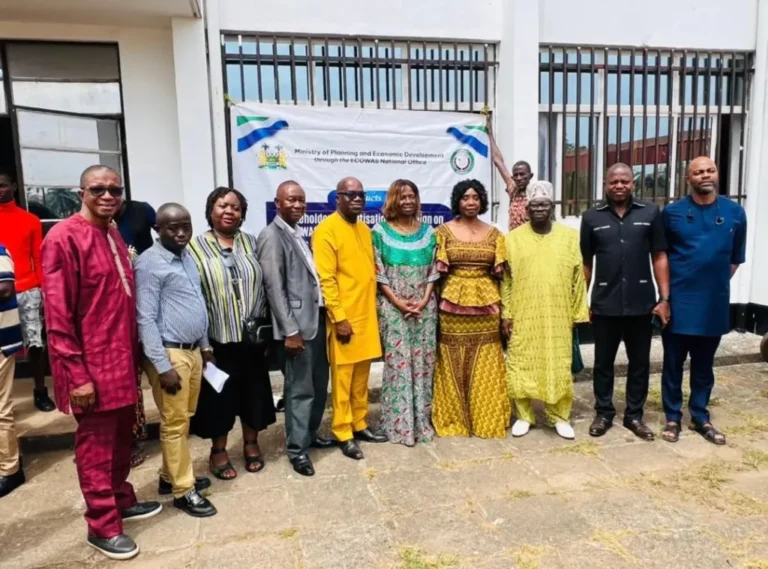
A high-level delegation recently concluded a strategic sensitization tour across Sierra Leone to bridge the gap between regional policy and local understanding.
Led by the Minister of Planning and Economic Development, Madam Kenyeh Barlay, and the ECOWAS Resident Representative, H.E. Ambassador John Azumah, the mission traveled through the districts of Kambia, Koinadugu, Tonkolili, and Kono. The delegation included diverse expertise from the National Early Warning and Response Mechanism Centre (NEWRMC) and the Ministry of Trade and Commerce, ensuring a comprehensive dialogue on security and economic integration.
The tour utilized a two-track engagement strategy designed to reach both the future generation and current community leaders. In the first phase, the delegation held sessions at secondary schools in each district, introducing students to the history and mandate of ECOWAS. These interactive Q&A sessions allowed students to move beyond theoretical knowledge and engage directly with officials on topics such as youth empowerment and regional peace. This approach aimed to solidify the concept of “ECOWAS of the People,” fostering a sense of community belonging among the youth.
Following the youth engagements, the mission convened broader stakeholder meetings involving traditional leaders, civil society organizations, security actors, and traders. These discussions were rooted in the “ECOWAS Vision 2050,” focusing on how regional cooperation can solve local challenges in food security, democratic governance, and trade facilitation. The presence of trade officials was particularly significant, as they provided essential clarifications on the ECOWAS Trade Liberalisation Scheme (ETLS) and how regional market frameworks can practically benefit Sierra Leonean businesses and artisans.
The tour emphasized the deep alignment between Sierra Leone’s national development goals and the broader regional priorities of the West African community. Minister Barlay underscored the country’s active role within ECOWAS, while Ambassador Azumah reiterated that regional integration is only successful when it yields tangible benefits for ordinary citizens. By incorporating feedback from these local authorities and disability groups, the mission has generated a vital roadmap for future programming, ensuring that the drive toward regional prosperity remains grounded in the needs of the various districts.
ABJ/APA