





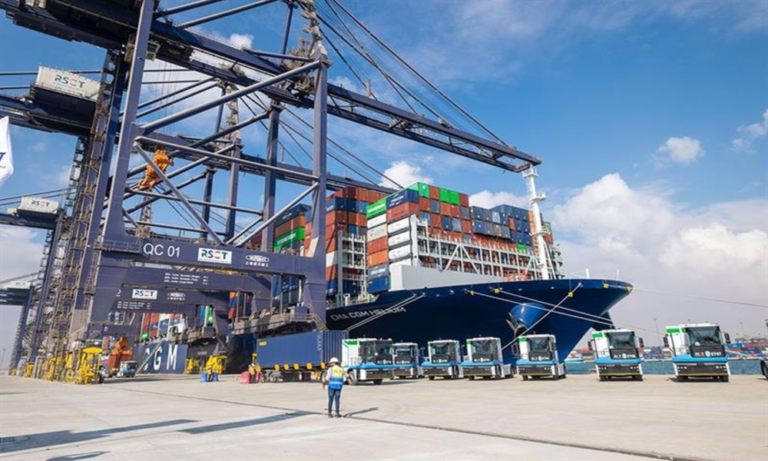
Egypt achieved a landmark 17% increase in non-oil exports during 2025, reaching a total of $48.5 billion compared to $41.5 billion the previous year.
This surge represents one of the strongest growth periods for the nation’s non-hydrocarbon trade in recent years and was a primary factor in reducing the national trade deficit by 9%. While imports rose moderately by 5% to $83 billion, the rapid acceleration of outbound goods helped stabilize Egypt’s primary trade indicators.
The most significant driver of this growth was a massive spike in gold exports, which more than doubled from $3.2 billion in 2024 to $7.6 billion in 2025. This unexpected boom was fueled by sharply rising global prices for precious metals throughout the year. Beyond gold, the export structure was led by construction materials at $14.8 billion, followed by chemicals and fertilizers at $9.4 billion. The agri-food and electronic engineering sectors also showed solid performances, contributing $6.8 billion and $6.4 billion respectively, as Egypt successfully diversified its trade reach into markets like the United Arab Emirates, Saudi Arabia, and Turkey.
Despite these gains in the non-oil sector, Egypt continues to face significant pressure within its energy industry. Rising domestic demand has forced the government to keep more production for local use, leading to a nearly 30% drop in petroleum product sales as of October 2025. To combat this, the government is working with international firms like Eni, Shell, and Chevron to accelerate exploration in the Mediterranean and the Delta. The administration aims to push natural gas production to 5 billion cubic feet per day by the end of 2025, while increasingly relying on non-oil industries to ensure long-term stability for the country’s current account.
MK/AK/Sf/fss/abj/APA