





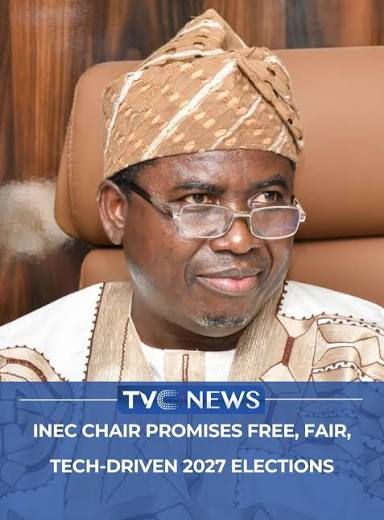
The Chairman of the Independent National Electoral Commission (INEC), Professor Joash Amupitan, has declared that winners of the 2027 general elections will be determined by the votes of the electorate.
Delivering the keynote address at the 10th annual conference of the Guild of Online Publishers (GOCOP) in Lagos, Professor Amupitan tasked members of the GOCOP and the media in general to support the efforts to deepen democracy through a thorough democratic process ahead of the upcoming general elections.
Speaking on the theme “2027 Elections: Trust, Transparency and Shared Responsibilities”, he declared that INEC does not have a preferred candidate, party or is the electoral umpire protecting any kind of institutional interest.
“Let me tell you, on behalf of the commission, that in the 2027 election, by the grace of God, what will determine the winner would be the votes of Nigerians and the will of Nigerians will prevail,” he said.
The INEC chairman, who was represented by Professor Ayobami Salami, Resident Electoral Commissioner (REC, in Lagos, asserted that the ultimate success of the 2027 general election would not be measured merely by the deployment of men and equipment, but also by the transparency of the process and the credibility of the outcomes and the sheer commitment of all stakeholders to safeguard the sanctity of the ballot box.
“Under my leadership, the Independent National Electoral Commission stands firm on an unshakeable promise, our sole allegiance is to the constitution and the law and our absolute obligation is to the Nigerian people.
“INEC has no preferred candidate, no favoured political party and no institutional interest, other than protecting the sacred and uncoerced will of Nigerian voters,” he said.
Charging online publishers to be part of the process of making the 2027 election a success, the chairman said that so much depended on the information infrastructure maintained by the media, particularly online publishers with regard to the election.
Amupitan pointed out the importance of the information infrastructure, warning that election windows were increasingly targeted by coordinated information warfare, political violence narratives, synthetic media, and AI-generated deep fakes designed to inflame passion and undermine institutional legitimacy.
He therefore charged the media to confront information disorder, reject click bait economics and remain the frontline stewards of truth.
He stated that fake news, unverified leaks, and sensationalised reports directly destroy public trust, incite civil unrest and induce voter apathy.
“When an unverified claim regarding electoral fraud is published, the damage to public confidence is immediate and enduring; subsequent retractions or fact-checks rarely repair the injury,” he added.
GIK/APA