





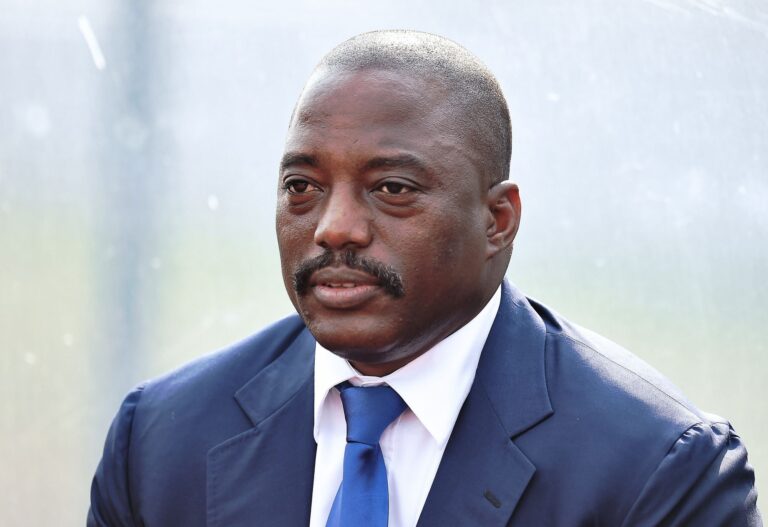
Former Democratic Republic of Congo (DRC) president Joseph Kabila has launched a new political and military coalition that includes the M23 rebel group and other opponents of President Félix Tshisekedi.
The new alliance, known as the Front for the Refoundation of the Nation (FRN), was unveiled on Monday at Kabila’s residence in Goma, the capital of North Kivu province.
It brings together various political and armed groups opposed to Tshisekedi’s administration, including factions previously grouped under the Congo River Alliance.
Former electoral commission chief and Congo River Alliance leader Corneille Nangaa, a key figure in the anti-government movement, will serve as one of the coalition’s four vice presidents.
Announcing the launch, coalition adviser Claude Ibalanky said the FRN aimed to restore what he described as the foundations of a functioning state and unite opposition forces against the current government.
“The signatories have decided to pool their forces, resources and means to create a framework for action through which all Congolese people, acting in unison, will undertake the task of liberating their country,” Ibalanky told journalists at the launch.
He said the coalition sought to coordinate resistance against what it characterised as “tyranny”, including through the use of force if necessary.
The announcement is expected to intensify political tensions and raise fresh concerns over the future of ongoing peace initiatives aimed at ending hostilities in eastern DRC.
The launch comes at a delicate moment for regional and international mediation efforts.
Although Kinshasa and M23 signed a United States-brokered peace agreement last year and later agreed on a roadmap for further talks, fighting and insecurity have persisted in parts of eastern Congo, undermining hopes for a durable settlement.
Eastern DRC has been plagued by armed violence for decades. More than 100 armed groups operate in the mineral-rich region bordering Rwanda, competing for territory, influence and access to natural resources.
The conflict has displaced millions of people and fuelled one of the world’s worst humanitarian crises.
M23 emerged as the most powerful of these groups after a rapid offensive that enabled it to seize Goma and other strategic towns across eastern Congo.
The Congolese government, the US and United Nations experts have repeatedly accused Rwanda of backing the rebel movement, allegations Kigali has consistently denied.
Kabila, who ruled Congo from 2001 to 2019 after the assassination of his father, Laurent Kabila, has increasingly found himself at odds with Tshisekedi’s administration since leaving office.
Last year, a military court sentenced him to death in absentia after convicting him of treason, war crimes and crimes against humanity.
Prosecutors accused him of collaborating with Rwanda and M23. Kabila rejected the charges, describing the proceedings as politically motivated.
Earlier this year, the US imposed sanctions on the former leader over allegations that he provided financial and political support to armed groups operating in eastern DRC.
His decision to openly join forces with M23 is likely to deepen divisions within the country and could further complicate efforts by regional leaders and international partners to stabilise eastern DRC and advance a lasting peace process.
JN/APA