





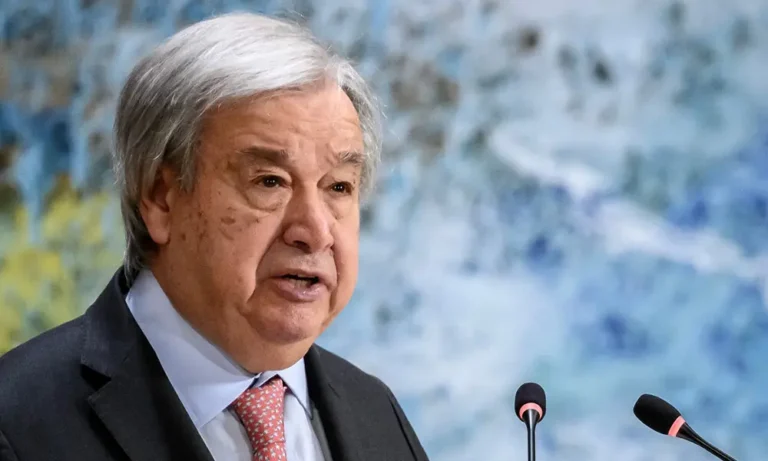
Following a formal protest lodged by Ghana with António Guterres on March 6, the UN Secretary-General has condemned the incident and announced the opening of an investigation, as Ghana demands that those responsible be brought to justice.
The UN Secretary-General António Guterres condemned the attack carried out on Friday, March 6, 2026, against Ghanaian peacekeepers of the United Nations Interim Force in Lebanon (UNIFIL) in Al Qawzah, in
southwestern Lebanon and announced the launch of an investigation, a day after Ghana filed a formal protest with the UN chief.
The attack, which occurred during intense exchanges of fire, seriously wounded two Ghanaian soldiers and left a third in a state of shock.
The battalion’s officers’ mess was completely destroyed by fire
following a missile strike. The injured were treated at a medical bunker before being evacuated to the UN Mission’s referral hospital in Beirut, where their condition is now reported as stable, while the remaining
troops were sheltered in underground bunkers.
As early as March 7, Ghana’s Ministry of Foreign Affairs announced the filing of a formal protest with Guterres. Minister Samuel Okudzeto Ablakwa, who transmitted the protest on behalf of the Ghanaian government, demanded a “full, immediate, impartial and transparent” investigation into the circumstances of the attack.
Ghana described the incident as a “serious violation of international law” that may amount to a war crime and called for those responsible to be identified and prosecuted.
The Ghanaian government also urged the UN to take all necessary measures to ensure the safety of the entire Ghanaian contingent deployed under the UN flag.
“The Government of Ghana assures its valiant soldiers that no effort will be spared in pursuing justice and ensuring enhanced protection,” the official statement read, reaffirming Ghana’s “unwavering commitment” to peacekeeping operations.
In response, the Secretary-General reaffirmed that “the safety and security of United Nations personnel and property must be respected at all times” and that “those responsible must be held accountable.”
The UN urged all parties to immediately de-escalate and fully comply with their obligations under Security Council Resolution 1701 (2006), the foundational text underpinning UNIFIL’s deployment in southern
Lebanon.
The incident comes amid a broader military escalation across the Middle East. In southern Lebanon, the Iranian-backed Shiite movement Hezbollah has stepped up rocket and drone attacks toward northern Israel in retaliation for joint Israeli-American strikes against Iran. In response, the Israel Defense Forces have launched airstrikes and
ground operations in southern Lebanon, triggering fighting, widespread destruction and civilian displacement.
UNIFIL, deployed since 1978 to monitor the cessation of hostilities along the “Blue Line” and support the Lebanese army in maintaining security, now finds itself increasingly exposed to the risks generated
by the military operations of the various parties to the conflict.
AC/lb/gik/APA