



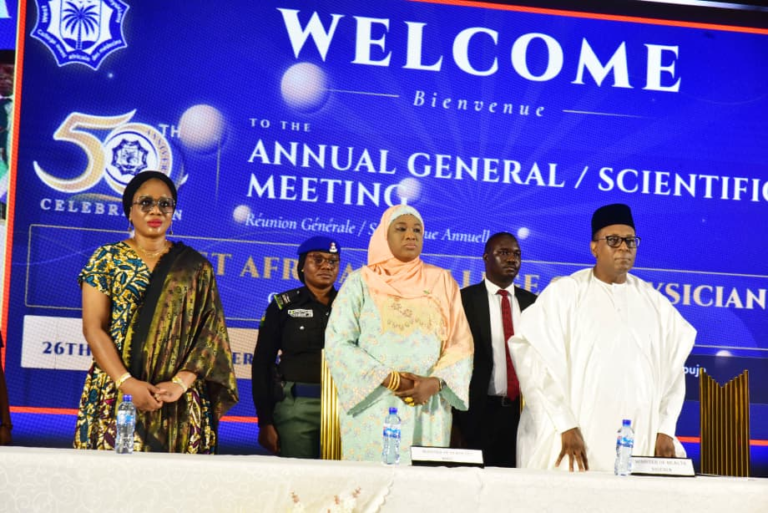
Nigerian President Bola Tinubu says that his administration has recruited more than 30,000 healthcare professionals into federal health facilities in the past two and a half years to strengthen Nigeria’s health system.
Represented by Nigeria’s Coordinating Minister of Health and Social Welfare, Prof. Muhammad Pate, Tinubu told the West African College of Physicians (WACP) 50th Annual General Meeting and Scientific Conference in Abuja on Monday that the Nigerian government had prioritised healthcare workforce recruitment, retention, welfare and training, recognising that the performance of any health system depended largely on the strength of its workforce.
He said that the administration had doubled quotas for medical education and supported the training of tens of thousands of frontline health workers to improve access to quality healthcare.
According to him, the Nigerian government was investing in postgraduate medical education, specialist institutions and digital innovations to improve healthcare management, patient records, disease surveillance and data-driven decision-making.
Tinubu said that the measures formed part of broader reforms aimed at advancing universal health coverage and ensuring equitable access to healthcare services for Nigerians across the country.
He disclosed that the government had invested in constructing, rehabilitating and equipping health facilities, while revitalising primary healthcare centres and increasing direct financing through the Basic Healthcare Provision Fund.
The Nigerian President also said that his administration had expanded health insurance coverage to bring more Nigerians under financial protection against catastrophic healthcare expenditure and reduce the burden of medical costs.
On healthcare professionals’ migration, Tinubu said that the government would work to stem the trend and encourage health workers to return to Nigeria and other countries in the region.
Tinubu called for stronger regional cooperation to prevent and control infectious disease outbreaks, including Ebola virus, through improved surveillance, laboratory networks, emergency preparedness and cross-border collaboration.
He said that Nigeria was ready to work with WACP, ECOWAS, the African Union and other partners to strengthen regional health security, while urging medical institutions to embrace innovation responsibly.
Speaking earlier at the event, the WACP President, Dr. Mamadou-Mourtalla Ka, said that the college had trained and certified thousands of specialist physicians who contributed to clinical practice, medical education, scientific research and health leadership across West Africa and beyond.
Ka said that the golden jubilee provided an opportunity to reflect on the institution’s achievements since its establishment in 1976 and consider its responsibilities in improving healthcare delivery across the sub-region.
He said that the college’s founding fathers had established it with a clear vision of promoting excellence in postgraduate medical education, strengthening professional standards and improving healthcare quality across West Africa.
According to him, the achievements recorded over five decades resulted from successive generations of physicians who sustained the college’s commitment to specialist training and professional development.
The president paid tribute to the founding fathers, past presidents, senior fellows, teachers and mentors whose dedication and perseverance had helped build the institution over the years.
He said that their contributions should inspire current members to preserve the college’s values, strengthen its unity and prepare the next generation of physicians for emerging healthcare challenges.
GIK/APA