



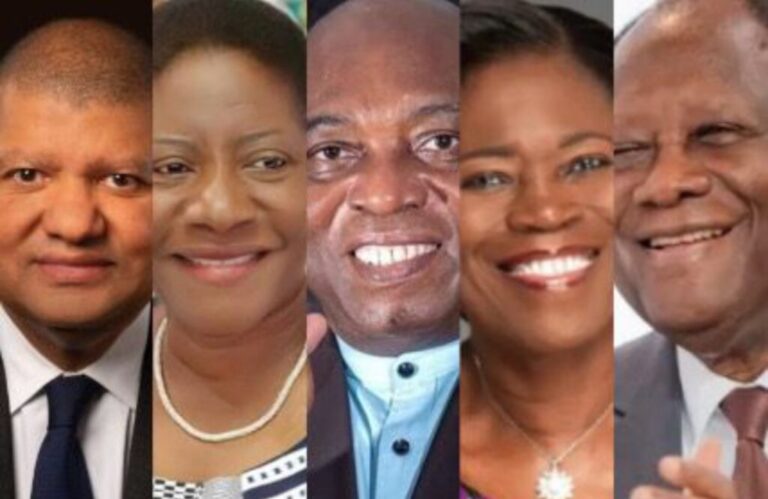
President Alassane Ouattara is bidding for a controversial fourth term in office as Ivory Coast heads to Saturday’s polls to elect the cocoa-producing country’s next leader.
Ivorians began turning up at polling stations in the economic capital Abidjan as early as 6am where long queues have formed with nine million citizens registered to vote.
Ouattara who has been in power since 2010, faces four other candidates for the Ivorian presidency including former First Lady Simone Gbagbo.
Her former husband Laurent Gbagbo, Ouattara’s predecessor who ruled Ivory Coast from 2000 to 2010 and ex Credit Suisse boss Tidjan Thiam were barred from running.
Their exclusion had led to protests on the streets of Abidjan and other cities in the lead up to the election.
Hundreds of their supporters are being detained.
Ouattara’s other challengers are his former commerce minister Jean-Loius Billion, civil engineer Ahoua Don Mello, and repeat candidate from the 2015 election, Henriette Lagou.
Aside from a semblance of political stability, the 83-year old former World Bank economist boast of presiding over robust economic growth since taking over Ivory Coast fifteen years ago.
Since 2011, the country has become an African economic powerhouse, posting growth rates that would put many economies around the world to shame.
However, behind the numbers, one question persists: has this growth truly changed the daily lives of Ivorians? When Ouattara came to power in 2011, the country was emerging from a decade of political and military turmoil with the economy on its knees.
Fourteen years later, the contrast has been unmistakable. Ivory Coast recorded an average annual growth rate of more than 8 percent between 2012 and 2019, then maintained the rate at around 6.5 percent through 2025.
Foreign investors have been flocking to the Ivory Coast, now the third-largest country in Africa in terms of attracting FDI, with $3.8 billion received in 2024, just behind Egypt and Ethiopia.
Rating agencies applaud the country’s fiscal discipline, restored stability, structural reforms, and a vigorous economic diversification strategy.
“Our resilience has been strengthened by the diversification of the economy,” Ouattara pointed out recently.
He presents himself as the guarantor of a country that has become stable and attractive for doing business once again.
Howver, his critics say economic growth has not transformed the quality of life of Ivorians. Some complained about growing inequality and economic hardship wich has risen by 37.5 percent.
Ivory Coast is the world’s biggest cocoa producer but processing agricultural raw materials and the rise of an extractive sector, driven by oil and gas, as well as the production of gold, coltan, and manganese, have diversified the country’s growth drivers.
In cashew nuts, for example, gross production increased from 380,000 tonnes in 2010 to over 1.2 million tonnes in 2023, representing nearly 40 percent of global supply. Local processing capacity, which has increased fivefold in less than a decade, exceeded 350,000 tonnes in 2024, generating over 18,000 jobs, two-thirds of which are held by women.
The discovery of the Baleine offshore deposit, located off the coast of Abidjan, in 2021 marked a turning point. In two years, oil production has surged, with a target of 60,000 barrels/day reached by 2024. Abidjan plans to triple this volume by 2027 and has already applied to join OPEC.
In 2011, at the end of the severe post-election crisis, more than one in two Ivorians lived below the poverty line. By 2021, this rate had already fallen to 37.5 percent, according to World Bank data, an unprecedented decline.
Projections for 2025 reinforce this trend. According to World Bank estimates, the poverty rate is expected to decline further, from 37.1 percent in 2024 to 34 percent in 2025.
WN/as/APA