



Rabat has hailed UN Security Council Resolution 2797, adopted on October 31, 2025 as a turning point in handling the Western Sahara dossier.
The resolution, which “enshrined the Moroccan Autonomy Initiative as the sole basis for settling this regional dispute, placing it at the heart of the political negotiation process,” also represents an
“irreversible turning point compared to all previous Security Council resolutions,” the head of Moroccan diplomacy said.
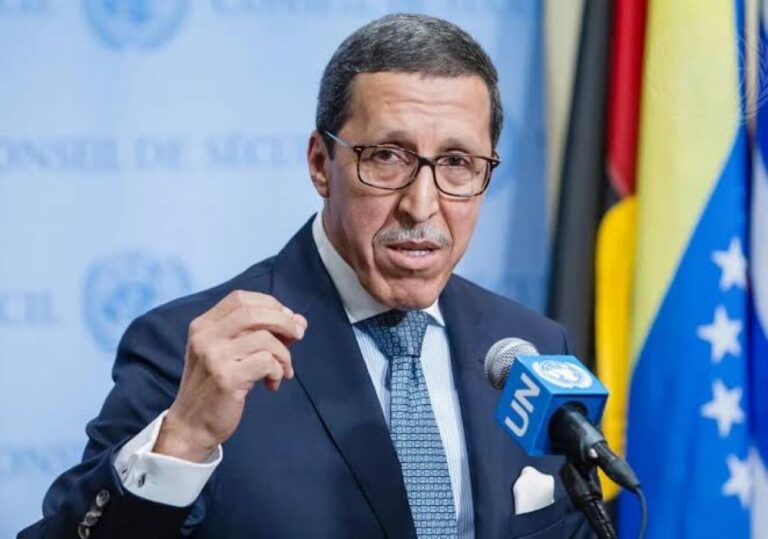
Speaking on Tuesday before the UN Fourth Committee in New York, Morocco’s Permanent Representative to the United Nations, Omar Hilale, pointed out that this resolution marked a “major shift” in the UN’s handling of the Moroccan Sahara dossier, “moving from a logic of
management to one of settlement.”
He emphasised that this resolution “enshrined the Moroccan Autonomy Initiative as the sole basis for settling this regional dispute, placing it at the heart of the political negotiation process.”
Resolution 2797 also – for the first time – “anchored the autonomy status within the framework of Moroccan sovereignty,” he further added.
He indicated that the UN document reaffirmed the responsibility of the four parties – Morocco, Algeria, Mauritania, and the ‘Polisario’ – calling upon them to engage in good faith and without preconditions in the search for a definitive political solution.
Furthermore, Resolution 2797 enabled direct discussions among the four parties – held during three meetings in Washington and Madrid under the co-chairmanship of the Secretary-General’s Personal Envoy and the U.S. Permanent Representative to the UN – and allowed Morocco to present its advanced autonomy status, detailing the mandates, powers, and competencies of the executive, legislative, and judicial bodies.
This autonomy, Mr. Hilale emphasized, “reconciles political realism, democratic governance, and the aspirations of the populations.”
While stressing that this “unprecedented political momentum requires each party to assume its historic responsibility in implementing this resolution,” Omar Hilale noted that Security Council resolutions “must be implemented; discussions must be conducted without preconditions; good faith must be demonstrated; commitments made must be honoured; and the ceasefire must be restored and observed.”
He warned that “managing this situation – the world’s second-longest-running refugee crisis – solely on a humanitarian basis cannot continue for another half-century.”
For this reason, the Moroccan diplomat called for the populations in the Tindouf camps to benefit from the durable solutions provided for under international law and the doctrine and practice of the United Nations High Commissioner for Refugees (UNHCR).
These durable solutions, he explained, are voluntary repatriation – for which King Mohammed VI has already issued a solemn appeal – resettlement in a third country, or integration into the host country, based on the free and voluntary choice of these populations.
“Any prevarication or imposition of conditions would be legally unlawful, politically immoral, and humanitarianly reprehensible,” he warned.
Regarding the identification of the parties to the political process, Hilale emphasised that the four parties to this dispute have been “duly identified in successive Security Council resolutions.”
He noted that the negotiations held in Washington and Madrid were attended by “the four parties identified by the Security Council – namely Morocco, Algeria, Mauritania, and the ‘Polisario’ – without any distinction or differentiation whatsoever.”
Furthermore, Hilale spoke out against rhetoric advocating for a referendum, which, in his view, “reflects an insidious disregard for Security Council resolutions.”
In this regard, he stressed that “the Security Council definitively buried the idea of a referendum a quarter of a century ago,” as did the Fourth Committee, whose resolutions – regularly adopted over the past twenty years – make no reference to a referendum.
AK/Sf/fss/as/APA