





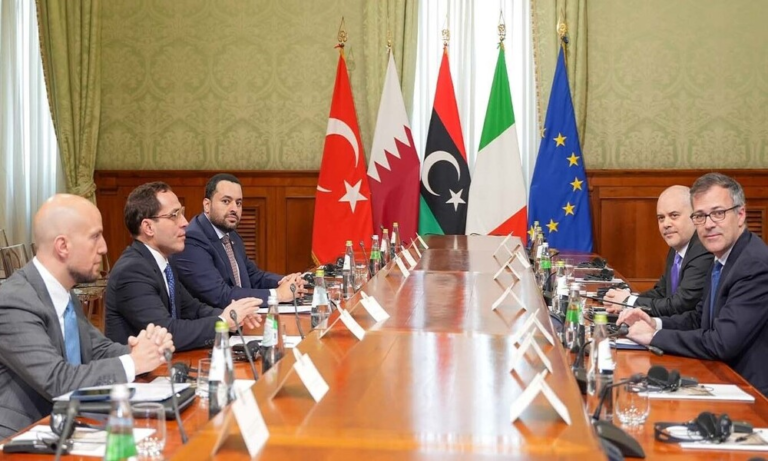
A high-level quadrilateral meeting bringing together representatives from Libya, Italy, Türkiye, and Qatar was held in Rome on Tuesday to reinforce security and logistical coordination in the fight against irregular migration networks operating across the Mediterranean.
According to information released by the Libyan government platform “Hakomitna,” the session convened the quadrilateral cooperation committee to address border controls and dismantle human trafficking cartels. The Libyan delegation featured Ibrahim Dbeibah, national security adviser to Prime Minister Abdulhamid Dbeibah, alongside Minister of State for Communication and Political Affairs Walid Ellafi. Italy was represented by Fabrizio Saggio, diplomatic and national security adviser to Prime Minister Giorgia Meloni, while Türkiye and Qatar sent senior presidential and diplomatic advisers Akif Çağatay Kılıç and Mohammed bin Abdulaziz Al Khulaifi, respectively.
Discussions during the summit focused on the outcomes of previous technical meetings and established new mechanisms to tighten security cooperation among the four states. Key topics on the table included boosting Libya’s border surveillance capacities, coordinating regional coastguard operations, and cutting off the financial and operational lifelines of migrant smuggling networks active along major Mediterranean routes. Libyan officials at the meeting reiterated that Tripoli views irregular migration through a triple lens of national sovereignty, state security, and humanitarian assistance, all of which require sustained international backing to effectively reinforce domestic institutions. Furthermore, the Libyan delegation firmly stressed that Libya cannot become a permanent settlement zone for migrants, calling instead for deeper cooperation with countries of origin and a dramatic expansion of voluntary return programs.
The strategic meeting arrives as the central Mediterranean route persists as one of the primary entry corridors into Europe. Data from the International Organization for Migration reveals that tens of thousands of migrants transit through Libyan coastal routes annually, despite heavily reinforced European and regional maritime surveillance efforts. Moving forward, the four nations reaffirmed their long-term commitment to maintaining both political and technical coordination under this quadrilateral framework. To turn these discussions into actionable field interventions, the committee finalized plans to establish a joint operations center designed to streamline real-time information sharing and launch synchronized actions against criminal trafficking syndicates operating in the southern Mediterranean.
MK/AK/Sf/lb/abj/APA