



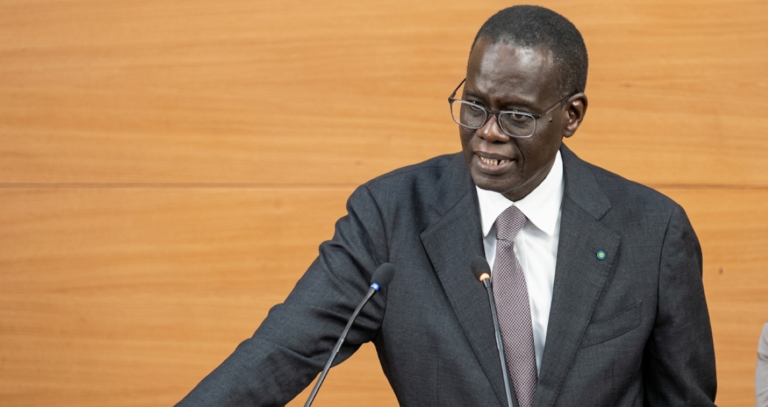
Amid concerns over public finances, Senegalese Prime Minister Al Aminou Lo sought to explain the government’s approach on Tuesday, defending subsidy reform and debt reprofiling as necessary measures to restore the state’s room for manoeuvre.
PM Al Aminou Lo explained measures set out in the programme with the International Monetary Fund (IMF), notably the rationalisation of public spending, subsidy reform, debt management and efforts to strengthen economic and energy sovereignty.
He said the programme’s broad policy priorities with the IMF largely reflect measures already included in the government’s programme and in the state’s previous commitments.
On public spending, he cited efforts to control the public-sector wage bill, optimise spending on goods and services and improve the efficiency of public investment.
He also recalled the plan to rationalise the parapublic sector presented to the Council of Ministers on March 4, 2026, which notably provides for the abolition of 19 agencies and the merger of several structures and entities.
Regarding subsidies, the prime minister announced a “gradual, predictable and differentiated” reduction in their cost, with the aim of bringing it down to 1% of GDP by 2029, or about 250 billion CFA francs. He said the government would henceforth favour subsidies targeted at vulnerable people rather than at products.
“We are not abolishing subsidies. We are rationalising them,” he said, adding that the reform would notably affect electricity and fuel subsidies.
On public debt, Al Aminou Lo said the government intended to restore debt sustainability, rebuild confidence and revive the economy. He said Senegal would favour debt “reprofiling”, notably through longer maturities and renegotiated interest rates, rather than a restructuring described as more far-reaching.
He said the approach would be supported by the IMF, the World Bank and other multilateral partners, while pledging to protect the interests of the population, particularly the most vulnerable.
The prime minister also addressed Senegal’s deteriorating credit rating, saying the five downgrades recorded reflected uncertainty over the country’s ability to turn its financial situation around. “We have taken responsibility,” he said.
On the energy sector, Al Aminou Lo stressed the need to turn oil and gas resources into cheaper electricity and industrial capacity. He notably announced that Senelec’s supply with liquefied natural gas (LNG) was expected to begin in January 2027.
He also called for an agreement with Mauritania and BP to allow Senegal to use part of the gas produced by the Grand Tortue Ahmeyim (GTA) project under terms he considers consistent with the agreements reached between the parties.
In the mining sector, the prime minister announced that a new mining code would be adopted before the end of 2026, along with the establishment of a rehabilitation fund for mining sites and quarries and a mining cadastre. He also set a target for the mining sector to generate 600 billion CFA francs in annual revenue by 2029.
Al Aminou Lo also stressed the importance of food sovereignty, with the ambition of meeting 64% of national rice needs by 2029, 114% of potato needs, 100% of onion needs, 96% of meat needs and 40% of milk needs.
He finally linked economic sovereignty to security and defence, saying the adoption of the military programming law and the framework law on the defence industrial and technological base needed to be accelerated, while calling for stronger protection of critical infrastructure, particularly oil, gas, electricity and digital infrastructure.
AC/lb/as/APA