



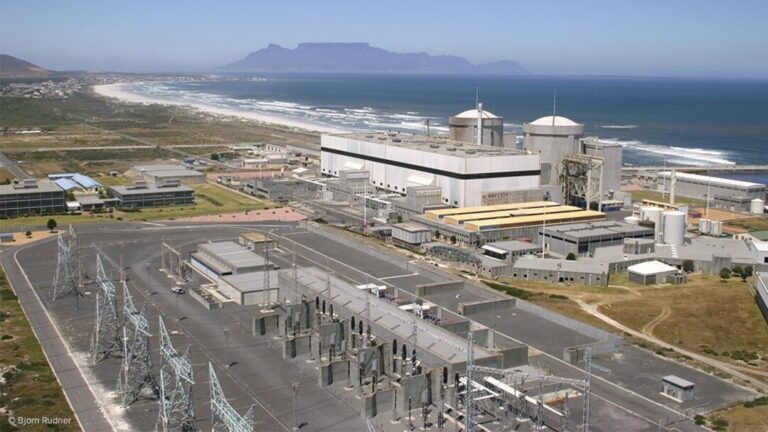
South Africa’s national power utility Eskom says a brief, localised rise in airborne radioactivity during routine steam‑generator maintenance at Koeberg Nuclear Power Station’s Unit 2 posed no risk to workers, the public or the environment.
The incident occurred on 2 and 7 July inside a controlled work area during Eddy Current Testing, a standard inspection method used worldwide to assess steam‑generator tube integrity.
Highly sensitive monitoring equipment detected a short‑lived increase in airborne microscopic oxide particles, known in the industry as “crud”, prompting an automatic alarm and a temporary halt to the inspection.
Eskom said the airborne activity was confined to the designated work zone within the Unit 2 containment building and did not result in any release of radioactive material beyond the plant’s protective barriers.
The event was classified as Level 0 on the International Nuclear and Radiological Event Scale, indicating no safety significance.
“The event had no impact on nuclear safety, plant operations, employees, the public or the environment,” Eskom said in a statement on Sunday.
Plant personnel secured the area, allowed ventilation and air filtration systems to clear the particles, and conducted radiological assessments before resuming maintenance.
The utility said Koeberg’s multiple layers of containment and monitoring operated exactly as designed, demonstrating the effectiveness of its defence‑in‑depth safety approach.
Unit 2 has been on a planned maintenance outage since April and remains on schedule to return to service in November while Unit 1 continues normal operation.
Eskom said the incident had no impact on nuclear safety, plant performance or outage timelines, and personnel involved received a full safety debriefing.
JN/APA