





Tunisian President Kaïs Saïed has called for strict sanctions against polluters and demanded firmer action from state agencies tasked with safeguarding the country’s coastline and archaeological heritage.
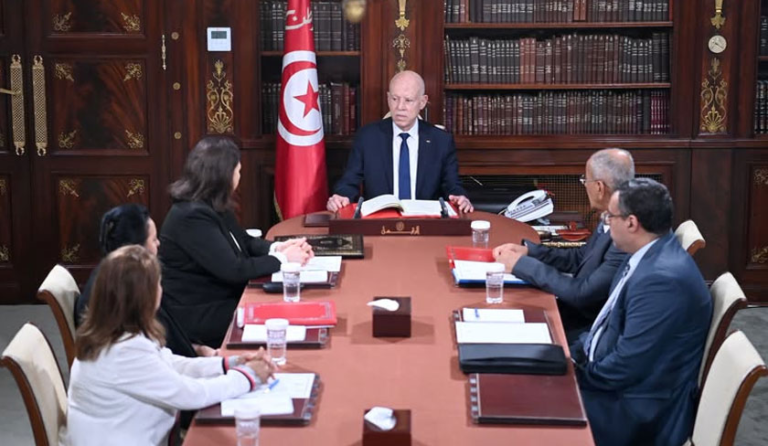
During an environmental policy meeting at Carthage Palace on August 3—held shortly after an unannounced site visit to Radès—President Saïed met with Prime Minister Sarra Zaâfrani Zenzri, the ministers of Environment and Cultural Affairs, and the heads of national coastal and heritage management bodies to address systemic conservation failures.
Emphasizing the direct liability of polluters, Saïed invoked the international “polluter pays” principle established at the 1992 Rio Earth Summit. He reiterated that Article 47 of the Tunisian Constitution explicitly guarantees citizens the right to a healthy, balanced environment while legally obligating the state to deploy all necessary resources against environmental degradation. However, the president directed his sharpest critique at institutional inertia, challenging the effectiveness of the Coastal Protection and Planning Agency (APAL) and asserting that creating public bodies is meaningless without tangible results on the ground.
Turning to cultural preservation, Saïed highlighted the recent accidental discovery of ancient artifacts along the banks of the Miliane River—a site that had devolved into an illegal dump—as evidence of widespread neglect. Warning that numerous historical relics remain uncataloged, poorly protected, or vulnerable to looting, he demanded accelerated maintenance projects, increased field inspections, and uncompromising enforcement. The presidential intervention signals a shift to hold state institutions directly accountable, framing coastal decay and heritage neglect as consequences of internal administrative failure alongside public wrongdoing.
MK/AK/Sf/lb/abj/APA