



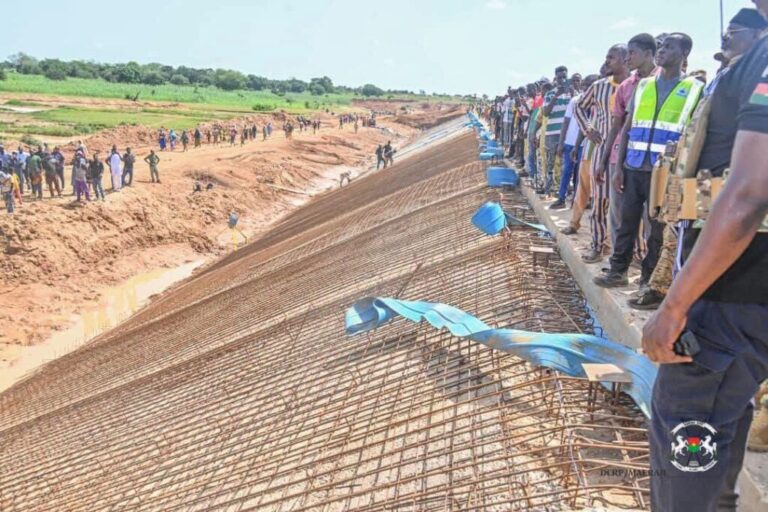
The Burkinabe government announced on Sunday that construction work on the Tougouya-koko dam in Zondoma Province (north) has surpassed 80% completion, following the takeover of the project by a public agency in April.
Burkinabe Minister of State for Agriculture, Water, and Animal and Fishery Resources, Commandant Ismael Sombie, visited Tougouya-koko in the commune of Bassi on Friday to assess the dam’s progress – estimated at 80% completion according to his ministry.
With a capacity of 15,567,987 cubic meters, the dam is designed to support agricultural, market gardening, and pastoral activities, as well as provide drinking water to the local population.
The project was initially awarded to a private company, but that firm had completed only 53% of the work despite having used up 132% of the contractual timeframe, according to the ministry. After several formal notices went unheeded, the contract was terminated.
The National Office for Dams and Hydro-Agricultural Developments (ONBAH) took over the project on April 1, 2026. Since the takeover, the physical completion rate has risen above 80%, up from the previous 53%, according to authorities.
“The facility will be ready to be filled with water in time for the next farming season,” the ministry stated, without specifying an exact date for commissioning.
Beyond its role in boosting agricultural and pastoral production, the dam is intended to help supply drinking water to Ouahigouya, the main city in northern Burkina Faso. The project includes plans for water extraction, treatment, and pumping from the dam to the city.
During his visit, Mr. Sombie commended the rapid progress made since the ONBAH took over the project, noting that the results demonstrated the capacity of public entities and local expertise to execute large-scale infrastructure projects.
The minister also reaffirmed the priority the authorities place on access to drinking water, stating: “Drinking water is a right, not a luxury.”
Burkina Faso, a Sahelian country facing significant rainfall variability, is seeking to develop its water infrastructure to support agriculture and improve public access to water.
HO/te/Sf/fss/as/APA