



ECOWAS has reaffirmed its intention to negotiate with Burkina Faso, Mali and Niger through a collective framework by extending until December 2026 the mandate of its chief negotiator, Lansana Kouyaté.
The decision comes as the Confederation of Sahel States (AES) has already harmonised its position ahead of talks aimed at establishing a new framework for relations between the two organisations.
The regional bloc still treats the trio as part of the ‘Ecowas family’.
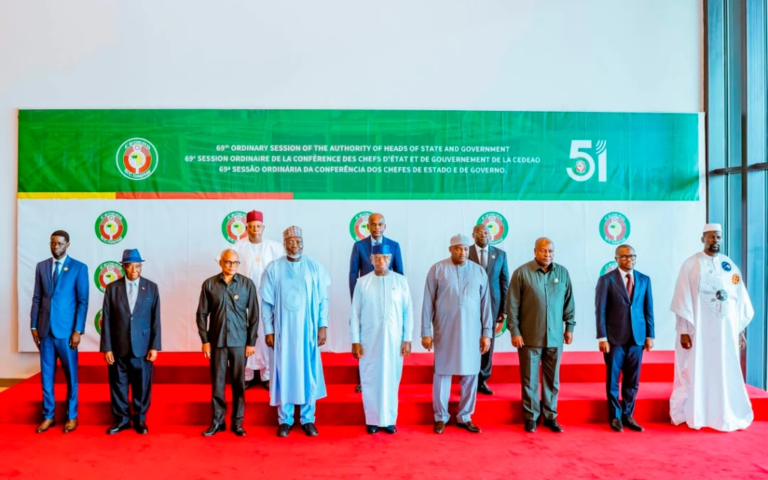
ECOWAS heads of state and government have decided to extend until December 2026 the mandate of their chief negotiator for relations with the Alliance of Sahel States (AES), Lansana Kouyaté, while reaffirming that discussions with Burkina Faso, Mali and Niger will continue exclusively within a collective framework.
Meeting on Sunday in Lungi, Sierra Leone, for their 69th Ordinary Session, West African leaders renewed their confidence in the former Guinean prime minister to continue the talks initiated with the three AES countries. They also called on ECOWAS member states to refrain from concluding separate bilateral agreements that could undermine the cohesion of the organisation, reiterating that negotiations with Burkina Faso, Mali and Niger would be conducted “exclusively as a unified bloc.”
This position echoes the strategy adopted by the Confederation of Sahel States, whose experts met in late June in Ouagadougou to harmonise the positions of the three countries ahead of the opening of formal negotiations with ECOWAS.
“The objective is to identify the confederation’s strategic interests, consolidate and harmonise our positions, while also preparing our arguments for the upcoming negotiation sessions with ECOWAS,” Herman Toé, Secretary-General of Burkina Faso’s Ministry of Foreign Affairs, said at the time.
According to him, the talks also aimed to safeguard the interests of populations within the AES area and across West Africa, particularly the gains achieved in terms of the free movement of people and goods.
The willingness of both organisations to maintain dialogue has also been demonstrated in recent months. In May, an informal meeting held in Lomé under the auspices of Togo’s President of the Council, Faure Gnassingbé, brought together the foreign ministers of the AES countries, ECOWAS Commission President Omar Alieu Touray and Lansana Kouyaté.
Talks focused on the foundations of a future cooperation framework, with particular emphasis on security issues, logistics corridors and the preservation of regional integration achievements.
On the occasion of the second anniversary of the AES Confederation on July 6, its current chairman, Captain Ibrahim Traoré, confirmed that consultations with ECOWAS were continuing in order to establish “a new framework for relations” based on respect for each side’s sovereign decisions, the preservation of regional integration gains and the defence of the interests of West African populations, particularly regarding the free movement of people and goods.
The decision adopted in Lungi confirms ECOWAS’ commitment to pursuing structured dialogue with the three Sahelian states while favouring a collective approach consistent with the position already adopted by the AES Confederation.
AC/Sf/lb/as/APA