





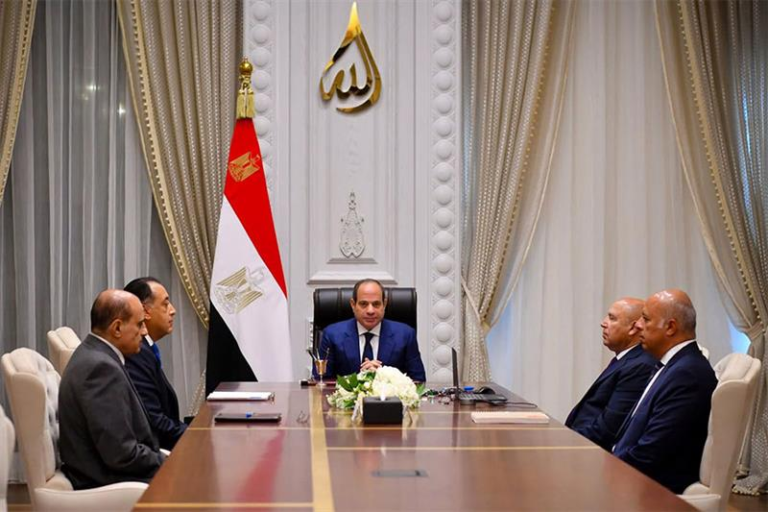
Egyptian President Abdel Fattah El-Sisi has issued strict directives to transport officials to accelerate the delivery of key national public transit and logistics projects while maintaining rigid adherence to quality standards and implementation timelines.
Following a high-level meeting in Al-Alamein with Prime Minister Mostafa Madbouly and Minister of Transport Kamel Al-Wazir, the presidency confirmed that major milestones across the country’s high-speed rail, monorail, and rapid bus networks are approaching operational readiness.
As part of the deployment timeline, Minister Al-Wazir announced that a six-month trial operation for Line 1 of the high-speed electric railway will begin in September 2026, linking Ain Sokhna on the Red Sea to Al-Alamein and Marsa Matrouh along the Mediterranean coast. Subsequent phases, including Lines 2 and 3, will connect newly reclaimed agricultural lands directly to urban consumer markets, export hubs, and prominent tourist destinations. In addition, Phase 2 of the Bus Rapid Transit (BRT) system along Cairo’s Ring Road is now ready for service, while the 43.8-kilometer West Nile Monorail—connecting 6th of October City to Mohandessin across 13 stations—is scheduled for a 2027 rollout to complement the ongoing East Nile Monorail line.
The sweeping infrastructure push also extends to strategic maritime and highway corridors aimed at positioning Egypt as a central trade hub bridging Africa and the Arab world. Development efforts encompass upgrades across key commercial ports at Safaga, Damietta, Alexandria, and Sokhna, alongside major road expansions such as the Western Desert Road connecting Giza to Abu Simbel and the 327-kilometer Aswan–Berenice corridor. President El-Sisi emphasized that seamlessly integrating these rail, road, and maritime assets will reduce transit times, optimize freight movement, and serve as a vital catalyst for long-term urban, industrial, and economic growth.
MK/Sf/lb/abj/APA