



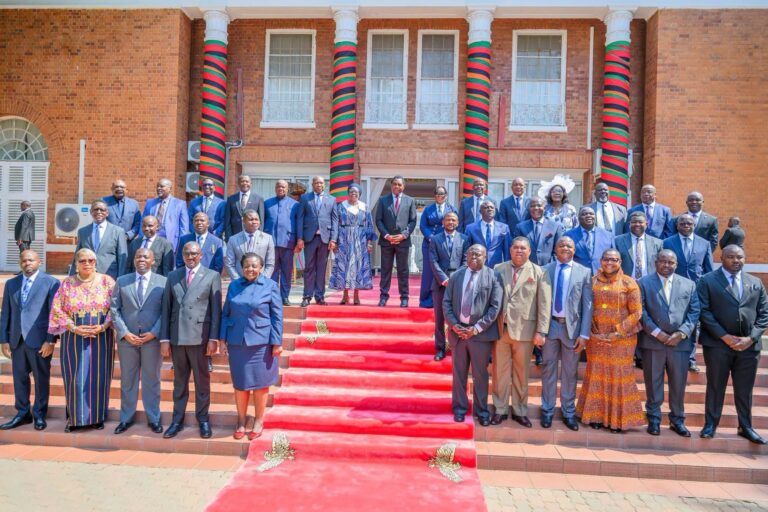
Zambian President Hakainde Hichilema on Wednesday swore in 24 ministers and 10 provincial ministers, completing the formation of his second-term cabinet following his re-election in August.
The ceremony at State House in Lusaka finalised a government structure that Hichilema says has been reshaped to accelerate delivery of his administration’s development agenda over the next five years.
Speaking after the ceremony, Hichilema said the reorganisation of ministries was intended to improve government performance and ensure development reaches all parts of the country.
“As a government, we have a duty and a responsibility to deliver equitable development to all our people. That is why we have carefully restructured and aligned the establishment of the ministries to ensure that the machinery of government delivers for the people of Zambia,” he said.
Among the appointments was Brenda Tambatamba who became Zambia’s first female minister of mines and minerals development, a significant appointment in Africa’s second-largest copper-producing nation.
Former Youth, Sport and Arts Minister Elvis Nkandu was named nformation and media minister and chief government spokesperson, while Frank Moyo, previously second deputy speaker of parliament, took over the agriculture portfolio.
The latest appointments come after Hichilema named an initial four ministers shortly after his inauguration on 1 September.
Those appointments covered the key portfolios of finance and national planning, health, foreign affairs and international cooperation, and green economy and environment.
Wednesday’s swearing-in also ushered in ministers assigned to several newly created ministries, including Trade and Exports, Petroleum, Electricity, Industry, Culture and Arts, and Skills and Higher Education as part of a broader restructuring of government.
The new cabinet will be tasked with driving Hichilema’s Grow Zambia Agenda, the centrepiece of his second-term programme after his first administration steered the country through a sovereign debt restructuring process and grappled with severe drought-induced power shortages.
Under the agenda, the government aims to raise annual copper production to three million tonnes by 2031, increase grain output to 10 million tonnes, expand electricity generation capacity to 10 gigawatts and attract five million tourists annually.
JN/APA