





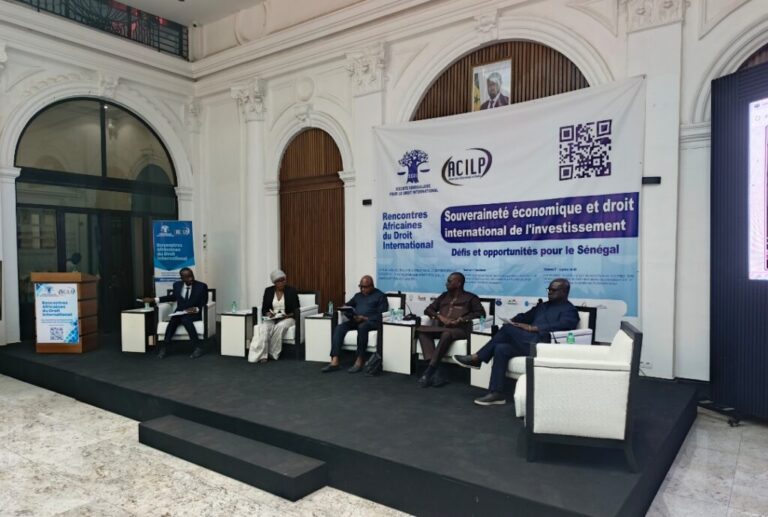
Experts converging for the inaugural African International Law Meetings (RADI) in the Senegalese capital are calling for far reaching reforms of the legal investment framework.
The meeting which attracted legal practitioners, and institutional representatives in Dakar, advocated for such reforms with a view to reconciling economic sovereignty with international obligations.
Organised by the Senegalese Society of International Law (SSDI) and the African Center of International Law Practice (ACILP), the first RADI session was held at the Dakar Chamber of Commerce under the theme: “Economic Sovereignty and International Investment Law: Challenges and Stakes for Senegal.”
Dr. Mouhamadou Madana Kane, president of ACILP, highlighted the shortcomings of certain bilateral investment treaties (BITs) signed by Senegal — particularly with the United States — which prohibit performance requirements or result-based obligations.
“These clauses may conflict with Senegal’s local content law, which is designed to support domestic companies in strategic sectors,” he warned, noting an imbalance that some investors could exploit before international arbitration tribunals.
In contrast, the BIT signed with Germany provides a better balance, according to Kane, allowing for regulatory measures on grounds of security, health, or sectoral restructuring.
An Unbalanced and Costly System
Taking the floor, Suzy Nikiema, Director of the Investment Law Center in Geneva, argued that the BIT regime, originally developed in the 1960s, “has failed to deliver on its development promises.”
“The system has mainly triggered costly litigation and deterred states from pursuing legitimate public policies due to fears of arbitration,” she stated, calling for a complete overhaul of the investment law framework, beyond cosmetic reforms.
She advocated for stricter regulation of damage calculation methods, third-party litigation funding practices, and a sustained effort by states to renegotiate or denounce outdated BITs.
A clear commitment
Speaking on behalf of the Senegalese Presidency, Special Advisor Marième Touré Lô reiterated her country’s commitment to its international agreements, while asserting its right to shape its economic policies.
“This openness must not come at the expense of our ability to define and implement policies in line with our national interests,” she stated, highlighting ongoing reforms such as the revision of the Investment Code, the reform of economic justice, and the digitalisation of public services.
She emphasised the need for “a balance between legal stability and adaptability, between investor protection and economic sovereignty.”
Toward an African investment law
SSDI President and ACILP Program Director, Me Aboubacar Fall, hailed the first RADI edition as a major initiative in the context of Senegal’s new economic direction.
“We must revisit BITs, reform the Investment Code, and draw inspiration from the Pan-African Investment Code and the AfCFTA Protocol,” he said, calling for the “Africanisation of investment law.”
According to Fall, the goal is clear: to equip African states with legal instruments that enable them to defend their interests effectively while remaining attractive to investors.
ODL/ac/sf/lb/as/APA