



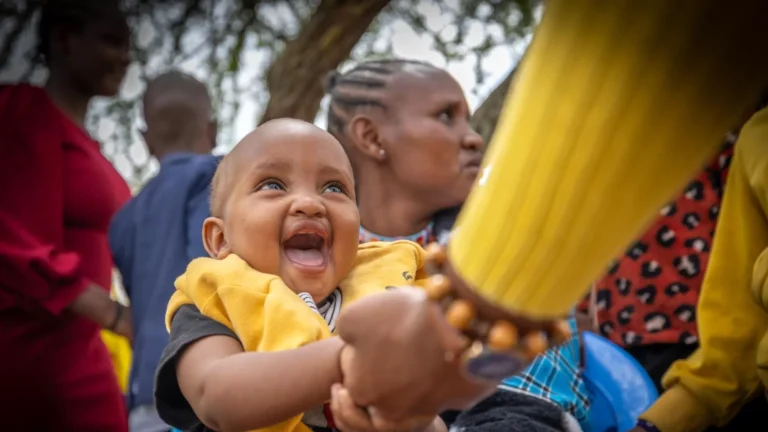
Eighty-five percent of Kenyan babies and toddlers aged between 3 and 23 months are growing very well, meeting the milestones expected for their age in movement, language and thinking, and social skills, according to a study revealed on Tuesday.
For the first time, Kenya’s national demographic and health survey has measured how the country’s youngest children are developing from as young as 3 months.
The 2025-26 Kenya Mini Demographic and Health Survey, launched in Nairobi on 3 November 2026, used the World Health Organization’s Global Scales for Early Development tool to check whether babies and toddlers are reaching the milestones expected for their age in movement, language and thinking, and social skills.
“For a long time, Kenya has tracked children’s survival and children’s growth. We have tracked mortality, immunization, height, and weight,” said Prof. Amina Abubakar of the Aga Khan University’s Institute for Human Development.
Now the survey also shows how young children are developing, county by county. “Counties can see where their children are falling behind so that they can target nurturing care, early stimulation, and parenting support where it’s needed most,” she said.
“Overall, 85% of children aged 3-23 months and 83% of children aged 24-59 months are developmentally on track, according to the report. Older children were assessed with UNICEF’s Early Childhood Development Index 2030,” Abubakar. Children whose mothers have more education are more likely to be on track.
Yet findings show substantial disparities between counties are large. “Among children aged 3-23 months, the proportion of children who are developmentally on track ranges from 52% in West Pokot to 97% in Kakamega for example,” said Makeba Shiroya, National Programme Officer for Child and Adolescent Health at WHO Kenya. “This data helps county policymakers target early-childhood support where it is needed most.”
Speaking on behalf of Dr Gary Conille, the United Nations Resident Coordinator for Kenya, WHO Representative to Kenya Dr Neema Rusibamayila Kimambo said, “Behind every indicator is a person, a mother seeking safe care, a child whose development depends on adequate nutrition support, an adolescent seeking information and services, and a woman facing violence. The decisions informed by this report will affect their lives.”
“The United Nations is proud to have supported this undertaking financially and technically through UNICEF, WHO, UNFPA, and UN Women,” she said. “Our agencies contributed to the survey design, field team training, analysis, and report development.”
The survey is the eighth demographic and health survey in Kenya since 1989 and the first mini survey. It gives an update on the health of Kenyan families between full surveys, which take place about every five years. It provides reliable evidence to track progress towards Kenya’s national health targets, the Sustainable Development Goals and Vision 2030. Led by the Kenya National Bureau of Statistics with the Ministry of Health, it collected data from 5 November 2025 to 10 February 2026 from a nationally representative sample of 29,935 households.
MG/abj/APA