



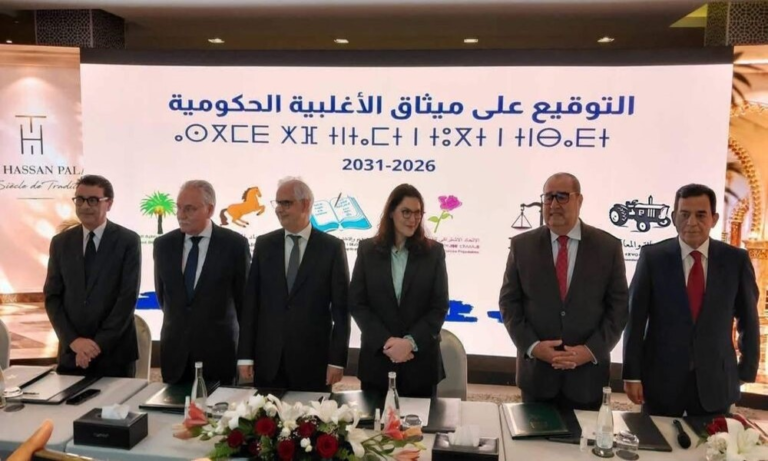
Morocco’s ruling coalition and its parliamentary allies formalized a political and ethical roadmap in Rabat on Tuesday evening, November 24, establishing binding rules for cooperation throughout the 2026–2031 legislative term.
Dubbed the “Majority Charter,” the pact is designed to strengthen executive-legislative coordination, combat corruption, narrow regional disparities, and ensure disciplined delivery of the government’s policy agenda.
The agreement unites six political formations: the four core parties composing the governing coalition—the Authenticity and Modernity Party (PAM), the Istiqlal Party, the Socialist Union of Popular Forces (USFP), and the Party of Progress and Socialism (PPS)—alongside two parliamentary support partners, the Constitutional Union (UC) and the Democratic and Social Movement (MDS). While the UC and MDS back the administration led by Head of Government Fatima Ezzahra El Mansouri, they remain outside the cabinet, holding no ministerial portfolios and preserving their political autonomy.
Anchored in four foundational principles—trust, solidarity, cohesion, and respect for commitments—the charter seeks to rebuild public confidence in elected institutions while translating policy pledges into tangible improvements in citizens’ daily lives. Among its overarching priorities, the pact underscores the defense of Morocco’s supreme national interests, sovereignty, and territorial integrity—most notably on the Sahara issue—alongside revitalizing structural reforms and consolidating the welfare state.
Addressing the signing ceremony, El Mansouri, who also coordinates the PAM’s collegial leadership, framed the coalition as a substantive political project rooted in mutual trust rather than a mere parliamentary headcount. She emphasized that the executive’s central mission is to convert shared commitments into concrete actions that protect Moroccans’ purchasing power, correct economic and social imbalances, and restore faith in public governance. Recalling that the four-party alliance emerged from extensive post-election consultations before opening up to supporting parties, El Mansouri praised the cooperative climate that has characterized the cabinet’s opening weeks. She added that recent sectoral meetings with ministers have focused on defining priority deliverables for the first 100 days, which she intends to mark the operational launch of the government’s program rather than a preliminary stocktaking exercise.
To institutionalize alignment over the next five years, the charter establishes a dedicated network of consultative bodies, including a majority presidency council, a joint committee bringing together the speakers of both chambers of Parliament, and two separate coordination bodies for the House of Representatives and the House of Councillors. These mechanisms will track the rollout of the government program, harmonize legislative and oversight initiatives, and deepen inter-party dialogue while respecting constitutional prerogatives and maintaining constructive engagement with the parliamentary opposition.
AK/lb/abj/APA