





The National Defense Administration and the Moroccan subsidiary of Harmattan AI – a French specialist in autonomous defence systems – signed a letter of intent on Wednesday, October 7, in Marrakech.
The agreement covers the “acquisition, development, and production in Morocco of IRIFI deep-strike systems,” an autonomous drone with a range of 2,000 km.
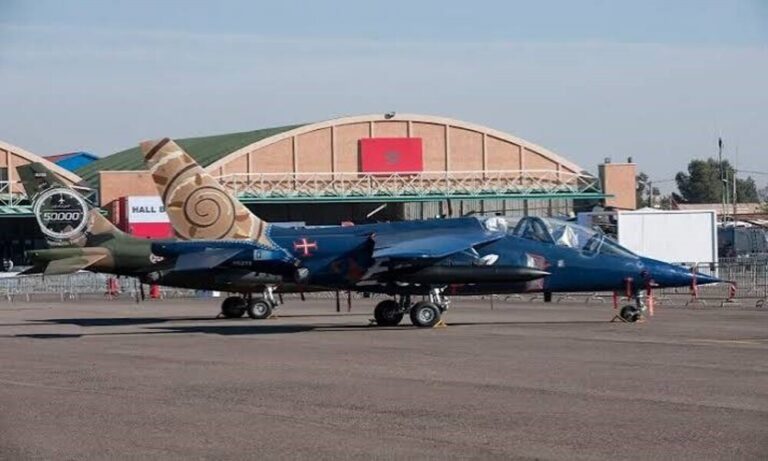
The signing took place during the opening session of the Marrakech Air Show, an international aerospace and defence exhibition running until October 10 at the Royal Air Force base in Marrakech.
The event was attended by Abdeltif Loudyi, Minister Delegate to the Head of Government in charge of the National Defence Administration and General Mohammed Berrid, Inspector General of the Royal Armed Forces (FAR) and Commander of the Southern Zone.
Harmattan AI co-founder and CEO Mouad M’Ghari and the Managing Director of the Moroccan subsidiary, Amir Benmahjoub – a former executive at the US firm Palantir – represented the company at the ceremony.
Harmattan AI describes IRIFI as a “long-range autonomous strike system” designed to “deliver precision effects within strategic depth.”
Powered by a combustion engine, the vehicle carries a classified payload and launches from a mobile, containerized unit designed for dispersed operations in contested environments.
Its onboard navigation system operates independently of Global Navigation Satellite Systems (GNSS), relying instead on visual guidance during the terminal phase.
Harmattan AI claims the system offers “metric-level” precision and the ability to fly “below radar detection.”
The engagement chain relies on a dual human authorization process: command-level approval of targets, firing positions, and mission parameters, followed by a final “green light” at the moment of llaunch. IRIFI then executes its mission end-to-end “without human intervention during execution,” allowing a single commander to initiate “dozens of autonomous strikes,” supported by an artificial intelligence system tasked with processing vast amounts of satellite imagery.
Harmattan AI positions IRIFI in the context of recent conflicts, which have been characterised by long-range strikes using low-cost, mass-produced systems against depots, industrial sites, airfields, command posts, and logistics hubs.
“The Shahed is cheap and easy to mass-produce, but it is inaccurate and easily shot down. Tomahawk and Storm Shadow missiles are technological marvels with high survivability, yet they are expensive and produced in very limited numbers. AI-driven autonomy now makes it possible to combine the best of both worlds, and that is exactly what Harmattan AI has achieved with IRIFI,” Mr. M’Ghari said.
This agreement builds upon the partnership established in June 2026 with the Royal Armed Forces (FAR) to strengthen sovereignty and develop a large-scale Moroccan defence industrial and technological base (DITB) starting in 2026.
In June 2026, Harmattan AI and the Royal Armed Forces signed a strategic partnership based on three pillars. The first entails establishing manufacturing capabilities in Morocco to produce autonomous defence systems.
The second initiative focuses on establishing an ambitious research and development centre dedicated to artificial intelligence applied to defence systems, while the third aims to forge partnerships with Moroccan higher education and research institutions.
The Marrakech Air Show – formerly known as AeroExpo Marrakech – is an international trade show dedicated to the aeronautics and space sectors. It has been held biennially at the military airbase in Marrakech, Morocco, since its inaugural edition in 2008.
With nearly 200 exhibitors from 27 countries and a Moroccan ecosystem comprising over 150 companies, the event positions itself as a strategic platform for the aeronautics, space and defence industries.
AK/Sf/fss/gik/APA